

It shouldn’t be a secret that Bend’s backyard offers some of the best adaptive skiing on the planet. While the able-bodied enjoy “Mt. Bachelor,” everyone else skis “OAS” — as those in the adaptive sports community call it. Two names for the same mountain, depending on who you ask. Oregon Adaptive Sports has been offering opportunities to adaptive skiers, young and old, inexperienced to the highest-level pros and instructors, since 1996, all driven by a team of volunteers.
If you ski at Bachelor, you will cross paths with some amazing people. Joanna Adams is one of them. Between monoskiing, being a wife and mother of two, working full-time as a neurosurgery physician assistant at OHSU and advocating for others with disabilities, Adams made time to chat with the Source Weekly — answers have been edited for brevity and clarity.
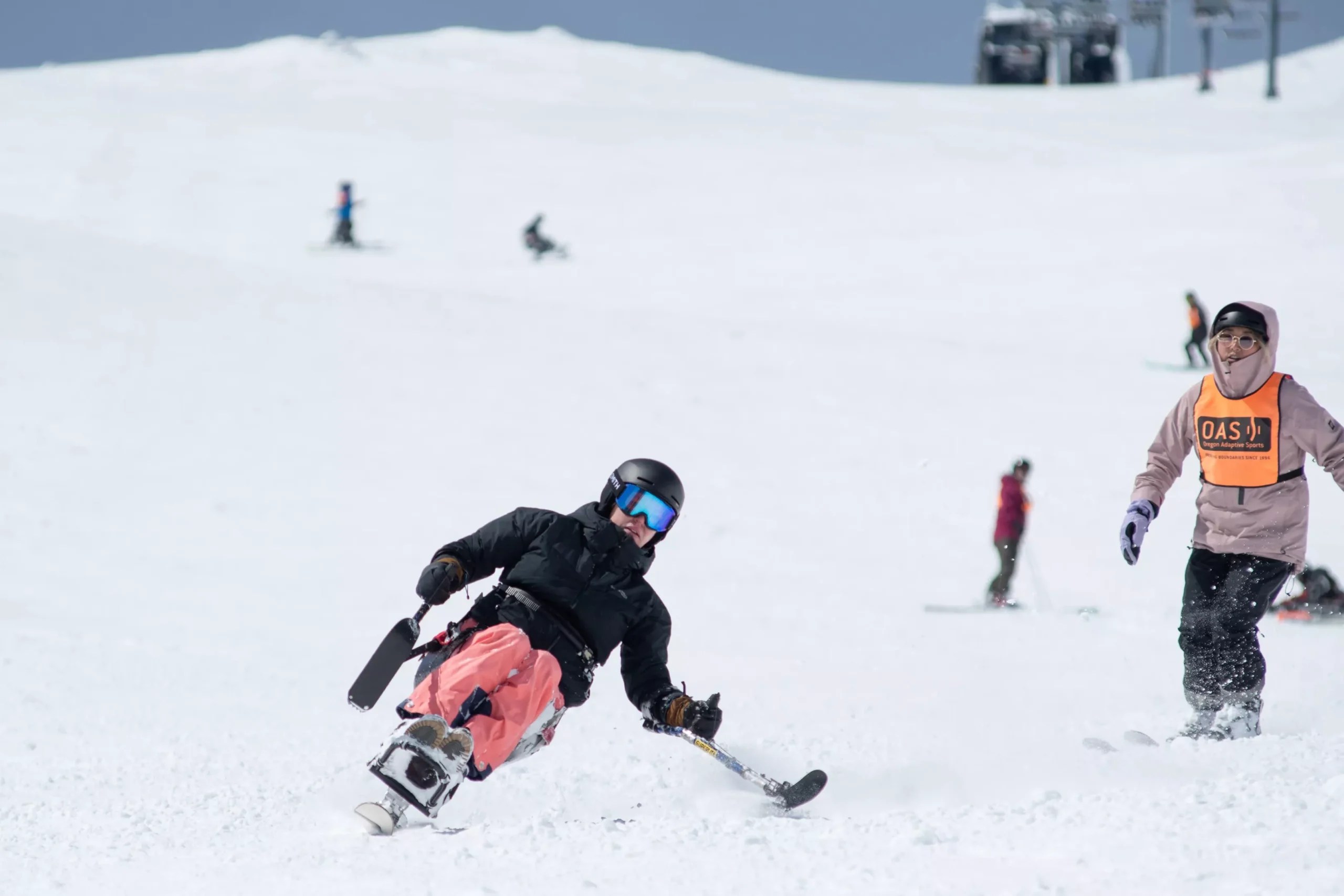
Source Weekly: Where are you from and how long have you been playing in the mountains of Oregon?
Joanna Adams: I am a native Oregonian! I was born in Portland. My family ancestry actually goes back to the Oregon Trail. My great-grandfather was a mail carrier and delivered mail in Portland during WWI. I have always been a recreational connoisseur of the mountains — we camped a lot growing up, and then as I transitioned into adulthood, I added activities like kayaking, backpacking, snowboarding and now monoskiing.
SW: What led you to OAS and how did you become a monoskier?
JA: I was injured on Mount Hood in a snowboarding accident when I was 21 years old and suffered a T7 spinal cord injury. I underwent emergency surgery at OHSU to stabilize my spine and then completed inpatient rehab at the Rehabilitation Institute of Oregon. Shortly after getting released from rehab, I was visiting OMSI and a gentleman came up to me who was also a wheelchair user. His name was Carl Backstrom, a Bend resident and disability advocate. All he asked was, “Are you new to this?” pointing to my wheelchair. Then, he asked if I was interested in adaptive skiing. I honestly didn’t know if I was since I was injured on the mountain, but said “yes” anyways. He gave me his card and said to contact him when I was ready. About two years later, I decided I was ready and got a hold of him. He told me about OAS in Bend and said all I had to do was give them a call and they would guide me through the process. OAS did a fantastic job of setting my expectations for a visit and helped me get set up with their scholarship fund so the cost was covered for me, and I was out on the mountain a few weeks later.
SW: Is there anything particular about Mt. Bachelor and OAS that the world should know?
JA: I joke that OAS is “the in-crowd” in Bend. It’s because this community includes and supports everyone. The hardest part for someone new is reaching out to ask for help doing something they’ve possibly never done before and not knowing what to expect. OAS gives that mental support from the beginning and follows through with expert activity support. Another key feature of OAS is the volunteer roster they have — there are hundreds of fun, adventurous and compassionate people who find joy by helping other people find their joy. This is a large part of why OAS is such a successful program.

SW: What has adaptive skiing taught you?
JA: It’s taught me that you can always learn something new from everyone: [a] volunteer, ski instructor or even someone you don’t directly know on the slopes. It has also taught me that the adaptive sports community is one of the most supportive and fun places to be a part of. If I was able-bodied, I would still want to be skiing with this same group.
SW: Have you been inspired by other adaptive ski athletes?
JA: The other adaptive ski athletes that have inspired me have all been the ones I’ve learned from personally or skied alongside. It’s these individuals that are doing what I’m doing, just a little bit better or faster. It’s the friends who started skiing after I learned and have now far surpassed me in ability. It’s the instructors who are in a monoski next to me showing me how to carve differently or maneuver in a better way. I am inspired by people who know and do better, slowing down to help other people come up to their level and encouraging others with every step. That being said, my biggest shout-out has to go to my husband who went out with me to Bend for my second lesson on the monoski after we had only been dating for two weeks. Ever since then, and discovering ADA parking in a ski lot, he has been with me for most of my snow adventures — constantly packing my equipment, picking me up after my falls and doing most of the driving to and from Portland. He’s encouraged, prepped, joked, massaged sore arms and been my constant that has made most of these snow adventures possible and fun.
SW: As someone who has overcome incredible adversity, what is your main message to the young women of America today in 2025?
JA: What matters most is being an advocate in your own local community. You can’t necessarily change the world, country or even your state; but you can change the community you are a part of and live in. How you interact with each person has a ripple effect. As a person with a physical disability, how I treat people is how they are likely going to turn around and treat the next person who has a similar disability. Be proud of who you are — there’s only one of you! — and choose to push for what you and your community needs. People who care and do will always make an improvement to people’s lives.
SW: Are there things Mt. Bachelor could improve on when it comes to ADA accessibility?
JA: Mt. Bachelor does a great job of making physical space for the OAS program, having plenty of wheelchair/ADA parking near the front areas and also teaching the lifties about monoskis and ways to help load/unload safely. Improvements could be for more wheelchair-accessible restrooms on all the levels of the lodges; an area where wheelchairs could be left near the ski check areas that could buffer wheelchairs from the elements; more space on the Summit Express lift lines for monoskiers to get through; and especially information on Mt. Bachelor’s web page directing adaptive athletes or people with adaptive ski needs to OAS’ ski programs.

SW: What’s it like working in neurosurgery at OHSU?
JA: I earned my master’s in physician assistant studies at Pacific University in Hillsboro. Neurosurgery at OHSU was my first job out of school and I’ve stayed since, which has been about 11 years. I’ve been fortunate to work in most of the specialty neurosurgery departments — pediatrics, skull base/cerebral vascular, spine, trauma and functional. I love making sense of neurological diseases and traumas that can be improved or even fixed with surgery. Patient education and expectation setting is paramount to having successful outcomes for patients. I love explaining people’s conditions to them so they can make the most educated and right decision for their lives. I’m fortunate to work with a team who is extremely compassionate and motivated to keep patients at the very center of every decision point. Part of my job also entails helping patients with new spinal cord injuries and their families understand what the road ahead of them looks like — not just medically, but socially and activity-wise. I can help them advocate for things they need in their recovery and set them up with local resources to continue giving them support after they have discharged from rehab. This is quite the full circle for me having been in the same hospital many years ago wondering the same things I am answering now for people. If I can make any of their lives smoother or less anxious, I am just grateful for the position I am in to support my community.
SW: Is any of it more rewarding than being a mom?
JA: Life is about balance and harvesting as much joy out of it as possible. I have immense joy from watching my children grow up and go through different stages, overcome problems and figure things out for themselves. I also have immense joy about overcoming my own obstacles and being an advocate for others. So I accept rewards in all forms and want to show my children that all of life can contribute to their happiness — I want them to see me happy with my husband, friends and family, happy with my job, happy with all the outdoor activities we spend time on and happy with who I am. If they see that rewards can come from anything and all are important, they have a chance at finding contentment in their own world that they create.
SW: Do you have any advice for someone who has never adaptive skied before but is thinking about trying it with OAS?
JA: Just call — or email — OAS and let them know what you would like to try and what your abilities are; they will help guide you through the next steps. All instructors meet everyone where they are at ability-wise, and the goal is to have fun and be outside. So, at the very least, you’ll meet awesome people, be outside and hopefully be having fun!
For more information about OAS, call 541-306-4774 or visit oregonadaptivesports.org
This article appears in The Source Weekly February 20, 2025.
MAKE LOCAL JOURNALISM HAPPEN


