

As a dog parent, there’s no better feeling than watching your dog run free, doing dog things and living their best life. These small freedoms are incredibly important to our dogs’ physical and mental well-being. We’re so privileged to live here in Central Oregon, where ample opportunities to give our dogs this freedom abound.
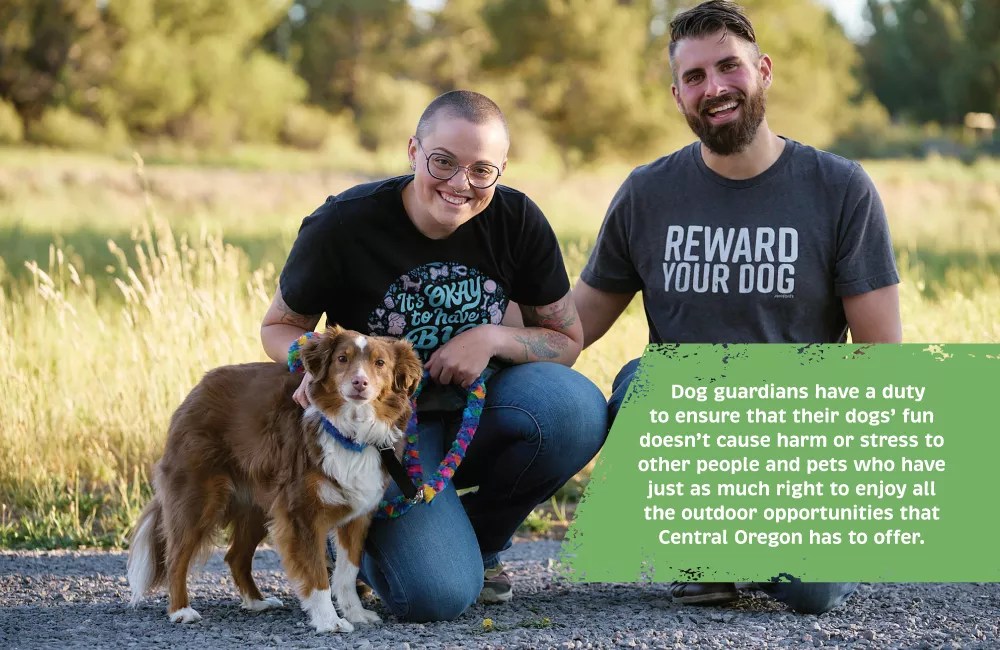
However, it’s important to realize that, as with everything, there’s an appropriate time and place for these off-leash activities. Dog guardians have a duty to ensure that their dogs’ fun doesn’t cause harm or stress to other people and pets who have just as much right to enjoy all the outdoor opportunities that Central Oregon has to offer.
A particular point of contention, of late, are the posted on-leash parks and trails in and around Bend. These parks and trails are marked with very clear signage designating these areas as on-leash only. The idea behind these designations is to provide both dog owners and non-dog owners a shared space to recreate safely. The reality is that some people are afraid of dogs. Some dogs are afraid of other dogs. Some people and animals have medical conditions that are exacerbated by dogs getting into their space, especially if that’s in the form of jumping, body slamming or even intensive sniffing and slobbering.
Keeping dogs on leash sends a clear message that there’s no need to worry: Your dog is under control and isn’t going to be a nuisance or trigger a fear response in anyone else sharing public spaces with you. Even if your dog is well-trained and under voice control, there’s no way for anyone you may encounter to know that for sure from a distance. It’s polite and considerate to follow leash laws, and failure to do so frequently results in dogs being prohibited from these areas altogether.
So, what if you are one of those people who would prefer to not be approached by strange dogs, or are a guardian of a dog who values their personal space? How do you handle encounters with off-leash dogs in areas where they aren’t supposed to be?
Firstly, be aware of your surroundings. If you see an off-leash dog in the distance and you don’t want to be approached, make that clear by preemptively making space. Move yourself (and your own dog, if you have one) off the trail or away from the off-leash dog’s trajectory. Make more space than you think you’ll need. Oftentimes, this will be enough to encourage the off-leash dog’s owner to collect or corral their dog, and if they don’t, you’ll be far enough away that the off-leash dog may not notice you, or at least will not be inclined to approach you if they do.
For dogs who don’t do well being approached by off-leash dogs, there are leash covers, vests and bandanas that contain warnings to give space or not to approach. It’s great to have these messages displayed, but oftentimes they go unnoticed until it’s too late.
If the off-leash dog’s guardian is within earshot, you can try calling out to them, politely asking them to please leash their dog. This is rarely effective, as most offending dog guardians tend to be preoccupied with telling you how friendly their off-leash dog is. The fact that the people or animals their off-leash dogs are approaching don’t share those friendly feelings is something that rarely occurs to someone who’s ignoring the leash law in the first place. If you have a dog with you, probably the most effective thing to call out is that your own dog is contagious. People will respond to that more reliably than you trying to tell them that your dog is afraid, or in training.
If an off-leash dog continues an unwanted advance, you have a few options. The simplest (and kindest) strategy is to have some dog treats on you, and as an off-leash dog approaches, toss a handful in front of them. This is likely to distract the dog until either you can move farther away, or their guardian can catch up to them. While it’s true that some dogs have dietary restrictions, it’s even more of a reason for those guardians to keep those dogs leashed and under control. Unleashed, out-of-control dogs are probably eating plenty of goodies off the ground unrelated to your tiny handful of treats.
Another option is to carry an umbrella with you, and pop it open toward the off-leash dog to startle and distract them from continuing their approach. If you have your own dog with you, be sure to acclimate your dog to the sight and sound of the opening umbrella ahead of time, to make sure you don’t startle them as well.
Compressed air and citronella sprays are other annoying deterrents that can be used to halt an unwanted approach. These things are unpleasant to experience, but if safety is a concern, can be useful in avoiding a conflict. Again, if your dog is with you, be careful of how you are using these, to avoid getting your own dog in the crossfire.
Emotions tend to run high during these situations, and it’s understandable that if you are dealing with an off-leash dog approaching you in an on-leash area, you might feel a bit annoyed. Expressing this annoyance to the off-leash dog’s guardian rarely works out.
If everyone is calm and safety isn’t a concern, you can try gently educating the off-leash dog’s guardian about why it’s important for their dog to be on-leash where posted. But let’s be real: No one likes being lectured by a stranger, and this isn’t likely to have the desired effect.
All of these strategies are labor intensive and inconvenient on the part of the people who are following the rules. It shouldn’t require so much effort to just enjoy a walk in the park with your leashed dog. Educating the offenders is key, but that education shouldn’t come from a brief encounter with a stranger on a trail. Instead, talk to your friends and relatives. Let them know that it’s not cool to let their dogs off leash where it’s not allowed, and let them know why.
As stated earlier, all dogs benefit from the freedom that comes with being off leash or on a long line. There’s no denying that. Luckily, there are a million other options out there for dogs to enjoy these freedoms. Check out some of our favorites!

Pine Nursery’s Dog Park has an extra-large fenced in area for dogs to stretch their legs and explore. The setup at Pine Nursery is actually pretty ideal, as you can let your dog get their crazies out in the off-leash area, and then utilize the on-leash walking path for a nice cool down period before heading home.
Good Dog! Dog Park is off-leash dog heaven. There’s an extensive network of trails that include river access, forest and beautiful scenery.
Alpenglow Park, similar to Pine Nursery, has a fun off-leash area (with areas for both big and small dogs) as well as an on-leash path for a nice walk.
Big Sky Park also has a nice off-leash trail with canal access.
If you’re looking for more solitude for your off-leash adventures, check out Sniffspot, a network of private dog parks available to rent for very reasonable rates.
Most official hiking trails along the Cascade Lakes highway are designated as off-leash from Sept. 15 to May 15 each year.
It’s important to keep in mind, though, that if you aren’t in a designated dog park area, it’s best to keep your dog close to you if you see other people on the trail, and don’t allow them to greet other hikers or other dogs until given permission. Off-leash doesn’t have to be a free-for-all, and it’s always nice to be courteous to fellow Central Oregonians who also want to enjoy the outdoors. As a bonus, you can impress them with you and your dog’s exemplary manners! And if you need some help with the dog manners part, there are plenty of us trainers in town who’d be happy to provide support.
—Rachelle Hein is a mom to three dogs as well as a certified veterinary technician (CVT) and dog trainer (ABCDT) who works with The Kind Canine Pet Services
This article appears in Central Oregon Pets Spring 2025.
MAKE LOCAL JOURNALISM HAPPEN


Central Oregon’s ever growing dog population brings upon more responsibilities to those with dogs, leashed and unleashed. Rachelle makes some excellent suggestions to help everyone stay safe!
Kristin Wolter
It’s simply not true that off-leash dog owners don’t care about the wellbeing of others. I am appalled by the divisive rhetoric in this article, which seems on the surface reasonable but in fact feeds further hatred towards dog parents who allow their dogs to enjoy life off-leash. If you yell at someone to leash their dog, like the author is suggesting, of course this is not the most effective way to avoid an encounter. The author suggests that off-leash dog owners don’t care about others — again, divisive and hate-fueling rhetoric. Instead of yelling at people to leash their dog, which opens up a whole discussion about leashing, one could instead yell out that they don’t want to meet or interact. Simple as that. Everyone I know who lets their dog off-leash responds quickly to this request. Otherwise, you’re yelling at off-leash dog people to do exactly what they don’t want to do, and if you know anything about human psychology, yelling at people to force them to do something is certainly not an effective way to get them to do it. Create empathy by stating your needs (“We don’t want to interact”) — and this creates a more connected and empathetic community (unlike this article).