


I have a complicated relationship with Quentin Tarantino. I rented “Reservoir Dogs” on VHS when I was 12 years old and it was the first movie that ever made me really understand the importance of dialogue in filmmaking. The way QT balanced tough guy dialogue with flawless needle drops and character-driven ultra violence felt like a revelation to me. Mr. Blonde dancing to “Stuck in the Middle With You” before slicing off a patrolman’s ear changed my brain forever and made me want to build a future around making movies and, if not that, then at least writing about them.
Two years later, “Pulp Fiction” changed film forever by revolutionizing structure, adding a spark to storytelling that felt like an entirely new genre of film was invented. Tarantino immediately became one of those filmmakers lucky enough to be still alive while being lionized as a genius and an auteur. As groundbreaking as “Pulp Fiction” was in some ways, and as blazingly entertaining as “Jackie Brown,” the “Kill Bill” duology and “Inglorious Basterds” are, it wasn’t until 2019’s “Once Upon a Time in Hollywood” that his filmmaking really matured and could stand on its own.
Because here’s the thing: there’s nothing in this world Tarantino loves more (aside from Uma Thurman’s feet) than genre movies and hearing himself talk about them. “Reservoir Dogs” is profoundly indebted to 1987’s Hong Kong action flick, “City on Fire.” His love of hardboiled, dime-store crime fiction influences “Pulp Fiction” from the ground up. With “Jackie Brown,” QT lovingly built a blaxploitation vehicle for Pam Grier from the foundation of her earlier work, like “Coffey” and “Foxy Brown.” The “Kill Bill’s” are a loving recreation of Shaw Brothers kung-fu flicks from the ‘60s and ‘70s. “Death Proof” is a grindhouse serial killer exploitation flick. With WWII thriller “Inglourious Basterds,” he would begin his revisionist history trilogy that would continue with the Antebellum revenge action movie “Django Unchained” and finish with the love letter to late ‘60s Los Angeles in “Once Upon a Time in Hollywood.” I think “The Hateful Eight” started from his love of American westerns and ended as a chamber piece retelling of “The Thing.” Not too sure about that one.
Tarantino’s encyclopedic knowledge of movies builds the bones of all of his work, which, while mostly still breathtakingly original, are still held together by his cinematic obsessions of yesteryear. Even as he has crafted some of the most iconic characters in film history (Jules Winnfield, The Bride and Hattori Hanzō just to name three), his filmography is also weighed down by homage, pastiche and outright theft.
After “Pulp Fiction’s” release and QT becoming feted by the media and filmmaking community, his ego became something of legend. So deeply involved in his own mythology that he wants to retire after making 10 films as to secure his own legacy, Tarantino turned this newly inflated ego toward his peers, publicly tearing down work that didn’t meet his limited and singular taste in cinema.
Tarantino is the worst kind of film bro cinephile: one who only has an extremely narrow window of what he appreciates and everything that exists outside of that limiting space is subject to cruel and thoughtless hot takes designed to make people feel like crap. From Paul Dano to Matthew Lillard and David Letterman, he has fallen into the trap of being controlled by his own, all-encompassing ego. He makes movie nerds look bad and I guess I kinda take that personally.
Ultimately, Tarantino has earned the right to comment on Hollywood in any way he wants, but the irony of him insulting anyone’s acting when, anytime he’s on camera in one of his own films, it’s easily the worst part of the movie. His acting in “Django Unchained” was so lifeless and his Australian accent so cartoonishly awful, I was pulled out of the world of the film, never to find my way back in. To call Dano “The weakest actor in SAG” must mean he’s never seen himself on camera before.
The point is this: every time Tarantino opens his mouth publicly lately, I’m growing to despise him more and more. His hot takes are weak, his taste in cinema is basic and juvenile and he seems to revel in being a blowhard bully spraying bile every which way he can…which is now sadly changing my relationship to his films. As much as I still respect and admire almost all of his movies, they’re holding less space in my heart as they once did.
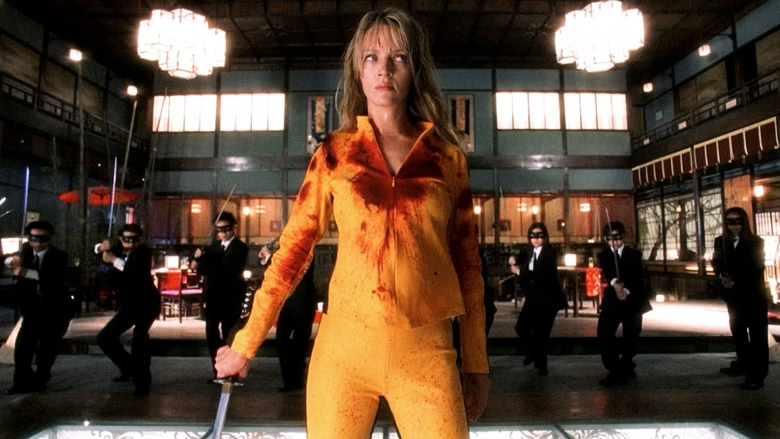
I’ve been waiting actual years to see “Kill Bill: The Whole Bloody Affair.” The film is the stuff of legend: a combination of “Kill Bill: Volumes 1 & 2” that adds new footage of O-Ren Ishii’s origin story and puts the color photography back into The House of Blue Leaves chapter, among other mostly cosmetic changes. It had been a long time since I’ve seen the “Kill Bill” films and having them play together, back to back (with a 15-minute intermission at the exact spot where the two films split) across 275 glorious minutes was worth the wait.
The film flies by, barely feeling like two hours, let alone four, and it’s easier to notice the sly thematic depth that QT and Uma Thurman baked into the story. The Bride’s revenge story isn’t just deeply personal for her, but is an archetypal scream of violent rage for all women (which is why we don’t learn The Bride’s name until near the end of the film). She is every single abused woman on an odyssey to destroy her abuser (a faceless man for half of the runtime), who cathartically earns her happy ending through suffering and redemption.
It’s still one hell of a movie, 20 years later. My issues with the film have always been there, like David Carradine being miscast as Bill (imagine that role played by Warren Beatty or Redford) and Tarantino letting his peculiar peccadillos lead the script down one or two pointless dead ends. Still, the film remains an iconic masterclass in action cinema. If you didn’t like the movie 20 years ago, however, “The Whole Bloody Affair” won’t recontextualize the film enough to change your mind. It’s still the same movies, just made into one. Watching them as a double feature on your couch will give you a similar experience.
What’s incredibly embarrassing, however, is the post-credit sequence…a ten-minute animated short called “The Lost Chapter: Yuki’s Revenge.” It follows Gogo Yubari’s sister, Yuki, who has come to America to enact revenge on The Bride for the death of Gogo. It’s without question the worst thing QT has ever had associated with his name in film. The entirety of the short was built with Unreal Engine 5, uses Fortnite models and skins and premiered a few weeks ago in Fortnite. This is corporate synergy at its absolute worst, adding a terrible short film, shoddily written and animated, to the end of a great movie to sell Fortnite to cinephiles. It’s cynical, ugly and hurts QT’s endless claims about the purity of his love of cinema. Please, if you love “Kill Bill,” leave the theater before the credits end and spare yourself this embarrassing cash grab. Watching this felt akin to seeing Kubrick direct a car commercial.
So, here I am struggling with separating the art and the artist again. Maybe I’m aging out of QT’s earlier stuff, instead finding myself more drawn to “Once Upon a Time” and “Basterds” than the work drunk off of his own obsessions. I think I have to come to terms with the fact that, even though I will probably still watch or read any piece of art Tarantino puts his name on, I don’t think I ever want to be in a room with the guy. He’s exhausting and I’m already exhausted. You or I don’t have to like him to appreciate the brilliance of “The Whole Bloody Affair,” although it would be so much sweeter if we did.
Movie Trailer
“Kill Bill: The Whole Bloody Affair”
Directed by Quentin Tarantino
Grade: A
Grade for “The Lost Chapter:” F-
Now Playing at Regal Old Mill
This article appears in the Source December 18, 2025.
MAKE LOCAL JOURNALISM HAPPEN


You forgot to mention or maybe have not heard of some of QTs earlier work (most have not), but they are must see for any QT fans.
Four Rooms and True Romance are respectable movies that QT had a hand in.
Also, I am so glad I left Kill Bill when the credits started. Thank you for justifying that decision last Thursday night! It was late enough for me.
I should have mentioned those but I mostly just wanted to focus on films that were his singular vision as a writer/director. True Romance is probably my favorite thing with QT’s name on it, but it feels equally like a Tony Scott movie as it does one of Tarantino’s.
While reading this article I found myself having to go back and reread parts because I was, I guess, out of the loop. I didn’t know anything about QT’s recent comments, so I looked up the story about Paul Dano. Now I understand. A little background would have been helpful. Overall, I enjoy your reviews and the observations you make. When I looked up the Paul Dano story, Ethan Hawke had something thoughtful to say about it. He said Paul Dano will see how much people in Hollywood love him and his acting, and that QT just “talks talks talks”.
Apologies. I probably should have added more context to the Dano story. I always feel like if I see it everywhere online, that everyone else is too!