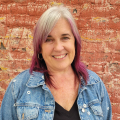
Skyler Brown fights back tears, seemingly conveying frustration at the world and her place in it. The Three Rivers artists says she’s “at the brink of madness. At the place where I am, I’m being forced to be appreciative for what you’ve got. But where the f— I am? How am I supposed to appreciate that?”
The heart-wrenching admission is part of a mobile docuseries project by two Central Oregon creators, melding videography, multimedia poetry, storytelling performances and intimate interviews with Black creatives across the state. Sketch + Release aims to lift up artists, build connections and foster conversations about difficult topics, according to multidisciplinary artist Jason McNeal Graham (also known as MOsley WOtta), 43, who enlisted Kenneth Adams, 46, to shoot and co-produce the episodes.

The duo has driven “over 5,000 miles, 120 hours, over the river and through the woods across this state to find out who else is here. That’s a lot of ground to cover just to ask somebody if they get where you’re coming from,” Graham says in Episode Zero. The duo spent time with creators, watching them at their craft and discussing their lives in their small communities. Graham and Adams have also taken some episodes on the road, screening them in small towns across the state, weaving in live performances, storytelling and dialog with the audience.
There are six episodes shot, Graham said, highlighting among others, Santigie and Sapata Fofana-Dura, brothers and sculptors in Woodburn, and Brown, an illustrator. There’s also an episode with Zina Louise Marie Allen, a Philomath artist, activist and poet. Screenings of Sketch + Release are slated for stops at Bend Church on Friday, Oct. 23; the Sunriver Library on Saturday, Oct. 24; the Redmond Library on Wednesday, Nov. 4; at The Belfry in Sisters on Thursday, Nov. 19; and at the Open Arts Center in Bend on Friday, Nov. 20. The tour has previously visited Aloha, Baker City, Boardman, Heppner, Hood River, Irrigon and La Grande.
Both Graham and Adams bring their own experience as artists in low-population areas to the project. Graham grew up in Bend, graduating from Mountain View High School in 2001, while Adams, a video artist, grew up in Florida. He lived in Augusta, Georgia, before moving to Bend. The two men say that while the project’s current focus is on Oregon creators, they aren’t limiting their scope. Rather, they have a vision of the project ultimately stretching across the country by working with other filmmakers and directors who pick up the mantle.
“That’s the beautiful part about this project. It just continues to grow as we meet new people. It’s a ripple effect,” Adams said. “We’re focusing on folks in rural communities, and we’re focusing on Oregon, but as we continue to meet folks, we’re also meeting other folks in surrounding areas, whether it’s Utah or Idaho or Montana. We have our work cut out for us, but we’re so excited about the idea.”

Graham said continued fundraising is what will keep the project going. Each stop on the tour is an opportunity for deepening conversations, fostering community and supporting the organic project. Donations will help fund future episodes, and the men are actively seeking other towns and spaces in which to share the series, “with people who care about art, rural life and Black futures in Oregon.
“It’s our vision and goal and dream to have this project fully supported by the community,” Graham said. “We’re actively looking for venues to showcase this and actively gathering support for this project, which we’re really proud of.”
The Source chatted with Adams and Graham about Sketch + Release. Answers have been lightly edited for clarity.
The Source: This is such an interesting, multidimensional project. Tell me about the history of it and what promoted you to pursue it?
Kenneth Adams: When I moved here, I didn’t meet another Black person for about five years. The first Black person that I actually met and talked to was Jason… I had transitioned into doing a little bit more community advocacy. I’d always been an artist when it comes to doing video work, but I never really had an inclination to fully put it out there because I wasn’t sure how it would be received and whether or not there would be an actual welcome to a Black man behind the camera in an area where there are very few of us. I jumped into a notion of making a documentary a few years back called “Blend: On Being Black in Bend” and that springboarded me into really digging back into video work and picking my camera back up. And then, Jason called me…Through the conduit of this project, it really helped boost my confidence. I realized I actually don’t need to create for people to see it. I just need to create because it’s something that’s coming out of my pores…The importance of this project is the fact that while we’re out on tour, you realize that even though you’re a silo, you’re not solo.
Jason McNeal Graham: This started as a way to help us find community and interweave with the community specific to the Black experience in Oregon and specific to Black artists in Oregon, which we both are. Sometimes it can feel like we are an island unto ourselves. But there’s a lot of us here. You just have to look.
I don’t think, after a certain point, the art was as much of an option as it was a necessary outlet for a myriad of experience, both very obvious and then with a quality of abstraction — because it’s so interwoven with the history of Oregon being an anti-Black, anti-slave state, and wanting to be able to participate in things that were talking about the Black experience but were also simultaneously transcending race and racism. We can’t deal with it by avoiding it. We have to go through it, and it felt like there were a lot of deliberate and conscious, and also subconscious, efforts to do anything other than talk about the brilliance of this Black experience as well as the collective addressing of long-standing wounds. Art was a place to deal with it in a very direct way…For me, largely the Black experience has been one that was isolating, and it wasn’t for lack of trying to engage with community. To Kenneth’s point, you might be siloed, but you’re not solo, which really resonates. I’ve been making poems. I’ve been making paintings. I’ve been making music. And I’ve been trying to say this in so many different ways to a community that doesn’t seem to understand that our histories are together, our histories are interwoven. This project was a way to really resonate with folks who aren’t going to run away from the difficult conversations.
TS: Do you feel like this project helps foster those conversations?
JMG: One thing I’ve found on tour is I’m realizing there’s a big scam. The big scam is we all hate each other and everything’s going to hell. I’m finding there are other realities available to us. I think the uniqueness of the racial topography in Oregon lends itself to people thinking that they can get away from it all when they come here, but the absence of us is an indication of the very same issues that might be more prevalent in the population of Chicago or Atlanta, or London or France. Places like Central Oregon give you the illusion that you can get away from, or escape or divert your attention, so it doesn’t affect you. There is no insulating ourselves from this. In less than an hour’s drive, depending on where you’re at, you can go to the reservation and see some of the realities that we’re dealing with globally, and some of the disparities that are part of the collective demand to wake up, because it doesn’t benefit any of us to be ignoring any of this.
KA: I just want to add one thought. I think avoidance boils down to not wanting to deal with one’s collective actions. I think that actually kind of spreads across the divide of different personalities, different infrastructures, whether it’s political, whether it’s in the arts, whether it’s in education…There are serious things that have happened in our society that still get swept under the rug. That avoidance is seen in multiple facets that all have a core in not wanting to deal with our country and our actions, the consequences of our actions.
TS: It sounds like the project uses art to relay these points and also the experience of the artists. Is that a correct interpretation?
JMG: This isn’t just an anomaly or one or two Black folks in Oregon. This is a whole bunch of folks. There’s something paradoxical in that we’re making a demand of folks to see themselves inside this project, wherever they come from. And we’re also making the demands, inside of this project, and when I say demand, that is said with severe love, that we walk through the taboo of “don’t talk about race and racism.” We need to do this. The end goal of this project is not to arrive, but to continue to move together. There’s several groups and communities that do the exact opposite of that. They don’t bring us together in community, and we are standing in defiance of that.
This article appears in the Source October 1, 2026.
MAKE LOCAL JOURNALISM HAPPEN