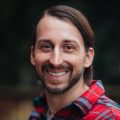
In layman’s terms, the “O Theory” states that “if everybody believes in something, then it works.”
This is according to groove-generating, Portland guitar wizard Scott Pemberton, who delved into operator belief theory during the pandemic times when he was working on his 2022 record, “Spot” — or “Scott Pemberton O Theory.”
“When there’s conflict, you [can] have an idea that’s parallel or intersecting — like perpendicular or complementary — to solve any problem. Which I think for improvised music, it’s pretty perfect,” Pemberton sums up.
He’s currently touring as an “organ trio format,” Pemberton says, with Tom Morrison on keyboards and synth bass and Casey Anderson on drums. “That’s the other thing I thought was cool with the ‘Spot’ name, because the OT could also be organ trio.” The record features guest brass from excellent Portland players including trumpeter Farnell Newton and saxophonist Steve Berlin of Los Lobos fame.

The Source Weekly spoke with Pemberton in advance of his Bend show at the Volcanic Theatre Pub on Friday, Nov. 22 with local funk, soul, reggae group The VibeShiftas featuring Brother Gabe (of Watkins Glen) and Sean Alan (of The Bond Brothers). Answers have been edited for brevity and clarity.
Source Weekly: With “O Theory,” I feel like you’re talking about jazz.
Scott Pemberton: Yeah, exactly. It really is true. You can choose to play a unison line. You [can] go for a harmony line. You [can] find something super different that will be complementary. I thought it would be neat to just name the album that concept, and then going into the touring trying to bear that in mind.
SW: How do you feel the concept shows itself on the record?
SP: One good example would be the song, “Shadow Dancer.” There’s an area in the body of the tune where there’s an ostinato pattern that maintains, then the drums go free, and then the guitar and the drums play angularly and complementary for probably like a minute while the bass is holding an ostinato pattern.
A lot of this was recorded and completed during the Covid lockdown. We weren’t able to always record live together, which might have been part of why I like calling it that, because I missed that live interaction, where it would be reacting to what other people are recording. In some ways, calling it the “O Theory,” I think it was kind of a longing for more of the live [experience], like trying to recreate what would happen live in a not-live instance. Because my live show is very reactive and improvisational. It was recreating that as best as we could with technology. The album does have a different kind of vibe, too; it’s a little bit mellower. Our live show is a little bit more of a dance party vibe. This album’s a little more contemplative. That’s a reflection of the instances that it was created [in]. You know, it wasn’t much of a party at the time.
“I remember sitting with a guitar in my lap, ringing the strings and having it seem like the most magical thing I could imagine.”
—Scott Pemberton on his earliest musical memory
SW: Where’d you grow up and learn to play music?
SP: I was born and raised in Portland. I played sax [in the school band] and then in high school I discovered the drum set. I started finding drums and bass and things that were more fun to rock out with my friends as a 15-year-old, being in little rock bands. In Portland at that time, the early ’90s, was just a really inclusive music scene. There was mad grunge happening, Nirvana was playing, [and] you could literally call [long-running punk venue] Satyricon… I called Satyricon from my job at Burger King and just booked a gig. They’d never heard the band. They’re like, “Sure, come play on Tuesday.” A lot of the venues had new band nights and stuff, and they were just very inclusive — a vibrant music scene at the time.
I started taking guitar dead serious my senior year in high school when I figured out this is actually what I want to do. I got expelled from high school, and that’s really when I started playing guitar. I was first tenor in the jazz band and sax was my more serious music outlet. Guitar was more of a rowdy, fun thing to do. So getting expelled really sent me down the full guitar path.
SW: Were all of these rock band instruments — drums, bass, guitar — self-taught?
SP: Yeah. Hear the sound, make the sound. I knew what I wanted the drums to sound like and then I could get them sounding like that. Remember, the music that was happening at the time too was not, you didn’t need a high level of proficiency, per se.
I had a friend in high school who was a great musician. He wanted me to play bass so he could play guitar for the school assembly. And he had me sit down and played me this cassette that was just a compilation of songs he had made that he liked, like covers. [He] said, “Pick one. Which one do you like?” I picked one that I liked, and he just taught it to me right then. The next day, we went and played it in front of 1,000 people at our high school.
SW: What song was it?
SP: It was “Dive” by Nirvana. This is pre – “Bleach” Nirvana. I remember it well. I could probably still play it. It was like magic — I could just listen to the song and he could just teach me to play it, and then boom! We’re playing it in front of people, who are responding positively. It was pretty exciting.
SW: What’s your earliest musical memory?
SP: I remember sitting with a guitar in my lap, ringing the strings and having it seem like the most magical thing I could imagine, wanting my dad to show me how to play it. It was one of my earliest memories. I might have even still been in diapers or barely out of them. I had it positioned across my lap, the way that I play overhand. I had it set up like that and I was kind of tapping on it. And then that was it. I didn’t try the guitar again till fifth grade.
Related Stories

Exploring New Constellations
This article appears in Source Weekly November 14, 2024.
MAKE LOCAL JOURNALISM HAPPEN