It’s a few minutes before 10am on July 18 and already the sun is baking the hills around Kah-Nee-Ta Hot Springs Resort on the Warm Springs Reservation. Six years ago, on Memorial Day, the storied resort shuttered following years of economic struggles. Over 100 people lost their jobs that day, most of them tribal members. It was an abrupt end to a dream realized in 1962, when Kah-Nee-Ta’s doors opened for the first time offering guests hot springs access and a hotel facility.
But today, on this hot, slightly hazy summer day, there’s a new hum in the air. After years of delays, and with $13.1 million poured in from the Confederated Tribes of Warm Springs ($6 million from the American Rescue Plan Act) and Kirk Hanna, owner of Mt. Hood Skibowl, the renovations and critical infrastructure repairs are complete. Opening day is finally here.
As I pull into the parking lot two attendants in sky-blue shirts with images of teepees running along one side stop me to ask who I’m meeting with – why I’m there an hour before the public gets let in. I’m told to park and head over a bridge to meet my guide for the day, Starla Green. As I walk over the bridge one of the men calls out to let me know, with a touch of pride in his voice, that the artificial turf laid out on the bridge is from Oregon State University’s football field. Even in this sovereign nation, Beaver fans abound.

On the other side of the Warm Springs River, I meet Starla Green and her 18-year-old daughter Kahmussa Green, who is Miss Warm Springs and the reservation’s cultural ambassador. For opening day, she’s wearing a long dress embossed in gold filigree against a rich brown background. Across her torso is her official “Miss Warm Springs” sash, atop her head a blue crown and on her feet leather moccasins. Kahmussa and Starla are direct descendants of the original Kah-Nee-Ta, the woman this land is named after.
Kah-Nee-Ta, Starla Green tells me, means root digger in Ichishkiin, the language of the Warm Springs Tribe. She died in 1903 and is buried in a cemetery near the end of the canyon, Green says, indicating the hills in the distance. This is the land she cared for and on it new generations are finding new ways to support themselves, while still holding on to tradition.
“A lot of us Indian women are actual food gatherers and still today go out and gather our foods,” Starla Green says. “Our roots, our berries.” The berries, huckleberries to be exact, grow wild around the reservation. Green, who in addition to being a media liaison and a key member of the resort’s design team, is also the resort’s kitchen manager, says that she hopes to use some of the local berries to top the Indian fry bread on offer in The Chinook Room, the resort restaurant. The fry bread is made by hand daily, an intensive process that produces delightfully crispy bread with a pillowy, airy interior.

As we walk into the hot spring-fed pool area, Green describes the significance of the “healing waters” and its use today. Up the river, she says are natural pools closed to the general public but still used regularly by tribal members.
Passing through the small poolside convenience store, we step out onto the pool deck, and it takes my eyes a minute to adjust to the bright sunlight bouncing off the light-sand colored deck and rows of white lounge chairs awaiting their first guests. The pools (there are multiple large soaking pools in the main area) sparkle like turquoise jewels set in white stone. Past the pools, hand-painted teepees are visible, and around the resort, as far as the eye can see, rolling hills are adorned with rocky outcrops and sparse green foliage. In front of us, the children’s splash pool features a tall mushroom-like feature spilling water continuously and an even taller water tower alternates dumping conical buckets of water. The effect stuns our small group into silence as we take it in. For a few moments, all we hear is falling water and birds calling in the distance.

Going once again into tour mode, Green gestures at the pools and gives a run-down of the features: The wellness hot spring pools and soaking tubs feature 32 minerals, state-of-the-art natural water treatment systems that reduce the need for chemicals like chlorine and increase in temperature as you walk along the deck.
There are private cabanas of varying sizes along the edges, each with a shade, a fan and outlets for charging devices. Toward the end of the pool area, a few employees are readying the outdoor bar, ensuring that the taps are running and all is ready for the guests’ imminent arrival. Above the pool area, on a ridge along the Warm Springs River are riverside cabanas with private soaking tubs and sofas. These private soaking tubs were a major new addition to the resort, and they’re priced as such, starting at $199 on weekdays.
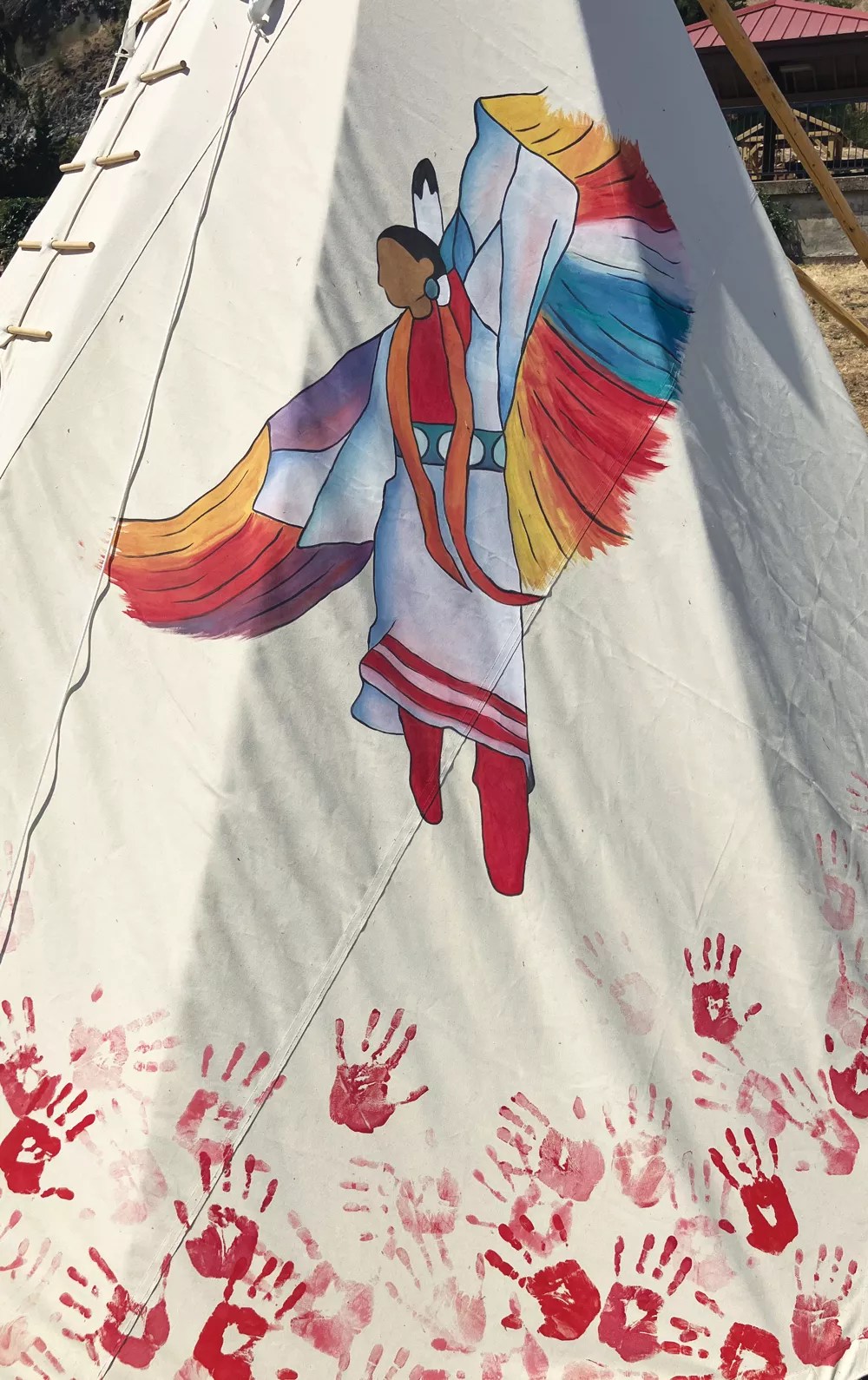
For those staying overnight, the resort offers 20 new teepees, all designed by Warm Springs artist Natalie Kirk and hand-painted by Nomadics Tipi Makers in Sisters. These were partly supported through a Visit Central Oregon grant as part of the Central Oregon Future Fund.

“This one is ‘She Who Watches,'” Green says, pointing to a slightly abstract image of a face. It’s an homage to the famous petroglyph in Washington’s Horsethief Lake State Park. “This is the old thunderbird design from our legends,” Green adds, pointing to another drawing. There are also images of bears, pronghorn antelopes and salmon. Among the animals are red handprints. The red-hand is a symbol of a growing movement to bring awareness to missing and murdered Indigenous women and girls. It’s typically shown over a person’s mouth as a symbol of the missing girls/women whose voices are not heard and the silence of media and law enforcement. Kahmussa says that the problem is one she feels deeply and that as a runner, she wears a red-hand print on herself while at competitions to bring more awareness to the issue.
Moving through the village area and back to the main building, Green stops to talk more about her connection to this land. “We actually lived here when I was very young,” she says. “When I was in grade school, because my mom worked out here and ran the stables. Back then they had employment housing and so we lived up here…my blood, sweat and tears is in this dirt.”
For her, Kah-Nee-Ta is more than a resort, a place to visit or even a place to work. Kah-Nee-Ta is where Green learned how to dance, how to do a traditional salmon bake. It’s where historic cultural customs are passed down and shared with people inside and outside of the community. The bakes and dances, Green says, will be held again on weekends soon. When the resort closed in 2018, it was a loss for tourism in the area, but Green says it never felt like a final loss for her.
“We were here when it closed. We did an exit parade with our people, the whole parade of people. We walked out, closed it out, but we didn’t give up,” she says. “We didn’t give up hope.” Instead, they started looking for a way to reopen. Jim Sauers, CEO of Kah-Nee-Ta and Warm Springs Economic Development Corporation, partnered with Hanna from Mt. Hood Skibowl to find a new way to position the resort. They hit on the idea of using the hot springs as the focal point and designed the renovation around the idea of the “healing waters.”
Drawing a parallel between the historic Indigenous experience and the resort, Green says she isn’t surprised Kah-Nee-Ta is back. “After everything that Indian people went through across the nation, we’re still here,” she says. “So same thing with Kah-Nee-Ta. Even though it went through struggles and it had to close, it did it for a reason, and now that it’s reopened it’s amazingly beautiful and we’re going to do the rest of it one phase at a time. Just like our Indian people. We’re back and we’re so happy.”

Though phase one is complete, a lot of work is still ahead. Staffing needs to ramp up, for one. Right now, the resort staffs around 100 employees, with 85% tribal members, but managers want to expand to 180. They’re still waiting on delivery of cold plunge tubs, and the extracurricular offerings like horseback riding and tubing the river are still a few weeks out. And there’s the old lodge and golf course that aren’t a part of this reopening.
The costs for a day pass and all the extras can quickly add up. An overnight stay requires a two-night minimum in either a hotel room, which starts at $249 per night, a teepee starting at $149 per night or an RV spot starting at $69. Still, people are coming.
A few minutes before 11am, Green’s walkie-talkie chirps and a voice announces that guests are arriving. She has another media interview to do, so she sends her daughter Kahmussa, who quickly walks to the front gates and over the footbridge to welcome a waiting crowd of visitors back to Kah-Nee-Ta.
Helpful Info:
Day Passes are required and are good from 11am – 7pm
Weekday: $29/day
Weekend: $39/day
Water activities with the day pass:
- Kids’ hot springs Heated Pool & Spray Park
- Hot springs heated lazy river and pool
- 4 hot springs pools heated from 100 – 104 with therapeutic jets in the two hotter ones
- Cold plunge tubs
Land activities with the day pass include:
- Kids disc golf
- Basketball courts
- Bocce ball courts
- Pickleball courts
- Miniature golf
- Ping-pong tables
Poolside Lounge Areas (11am to 7pm, first come, first served)
- Lounge Chair w/canopy and cushions: starting at $29 on weekdays / $49 on weekends
- Adult or Kids Cabanas, 2-person: starting at $59 on weekdays / $99 on weekends
- VIP Cabana, 8-person: starting at $175 on weekdays / $225 on weekends
- Party Cabana, 16-person: starting at $399 on weekdays / $499 on weekends
Overnight Accommodations
All overnight accommodations require a two-night minimum, and a resort pass per person per night after the first guest.
HOTEL:
- 30 remodeled rooms, range from 3-bedroom suites that can accommodate up to 12 guests or individual rooms for up to 4 people. Prices start around $250/night.
TEEPEE:
- 20 new, hand-painted Teepees are installed over the pre-existing cement slabs in Teepee Village. The Teepees sleep 10 (bring your camping equipment!).
- In a nod to cultural practices, Teepee Village has a Tribal fire pit for regular Tribal storytelling. Prices start around $150/night.
RV PARK:
- 50 RV sites with full hook-ups and 20 additional RV parking spots (coming soon). Prices start around $70/night.
Add-on Experiences
- 3-mile river tube float in Warm Springs River with shuttle service
- Guided horseback rides
- Tribal-guided fishing
—This story is powered by the Lay It Out Foundation, the nonprofit with a mission of promoting deep reporting and investigative journalism in Central Oregon. Learn more and be part of this important work by visiting layitoutfoundation.org.

This article appears in Source Weekly August 1, 2024.
MAKE LOCAL JOURNALISM HAPPEN