

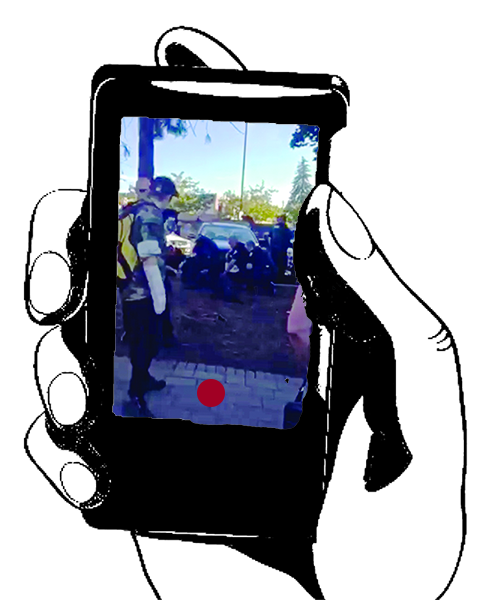
Last Wednesday, as the final Bend Farmers’ Market of the year was wrapping up, cop cars spilled into the parking lot between Brooks Street and the top of Drake Park. Before long, officers had surrounded a young, black man and brought him to the ground. Onlookers, unaware of any crime and unable to see clearly what was happening beyond the booths and cars, began to worry and to speculate.
One witness, who declined to be named, says she was working at a booth when she noticed a group of police officers. Though vehicles obstructed her view of the officers from the upper thighs down, she says she was worried they were kicking the man and treating him more roughly because of his race.
“I can’t confirm what was happening below that line, but it looked like they were being rough. I tried to get up higher on the wall to see because something felt really wrong at that point,” she says. “A lot more cops started showing up over the next few minutes. Way too many for arresting one person.”
Paul Arney, a local business owner who was in the area for a meeting, was likewise taken aback by the heavy police presence.
“I saw cop car after cop car after cop car,” Arney recalls. “I was wondering if somebody got shot or something.”
Bend Police Chief Jim Porter says that use of force in arrests is indeed uncommon. In 2013, only about one in every 50 arrests included force. But with the media attention surrounding the police shooting of unarmed black teen Michael Brown in the St. Louis suburb of Ferguson, the use of force—particularly against African Americans—is understandably subject to heightened scrutiny.
In cell phone video provided to the Source, a young, black man can be seen resisting, thrashing his body and jumping up and down. Eventually, officers take him to the ground as the man screams expletives at the officers, saying that he hasn’t done anything. In the background, someone encourages the man to remain calm, while others express concern about his treatment by police.
Police say the suspect is 19-year-old Courtney Cornis, arrested and charged Oct. 8 with minor in possession of alcohol, interfering with a police officer, disorderly conduct II and resisting arrest. What started as an attempt to issue a simple citation, police say, escalated into a confrontation requiring backup when, according to police, Cornis “lunged” at the female officer who was checking his identification and began making threats.
We talked to Chief Porter about how officers decide when to use force, what kind of training they receive with regard to race, and how the use of cell phone video impacts their job.
Source Weekly: What are the Bend PD’s policies with regard to use of force?
Chief Jim Porter: Bend Police officers are trained to use a reasonable amount of force, based upon the totality of the situation they are confronted with. This use of force ranges from their presence to the use of deadly physical force. Use of force situations are fluid, they can begin as a mere contact and escalate into a life and death encounter in seconds.
SW: How are police trained to respond to a suspect who is resisting arrest and/or intoxicated?
JP: It is important to remember as a rule it is the actions of the subject being encountered by the police that defines the amount of force used by the officers. Officers are trained to use the reasonable amount of force necessary to complete their task at hand. If allowed by the circumstances, officers will begin by attempting to de-escalate the situation verbally. Often the person who is intoxicated on controlled substances or alcohol is not open to de-escalation and the officer will have to use additional force. The majority of these encounters are the result of officers responding to a report the suspect is causing disturbances, has been involved in an altercation, or has made threats towards others. Those individuals who officers are forced to use force to apprehend have through actions or words brought the officers to them. With the dramatic increase in the numbers of individuals of mental health issues on our streets and with the reemergence of serious mood altering drugs, officers are more and more being faced with individuals who are not open for verbal de-escalation, but pose a danger to the public, themselves, and the officers they encounter.
SW: What kind of training do Bend PD officers receive regarding race and racism?
JP: Officers of the Bend Police Department participate in yearly training on issues of race and profiling. After the completion of training the officers are tested on their knowledge on these issues.
SW: How would you define “police brutality” or excessive use of force? How can witnesses tell if police behavior crosses the line, and how should they respond?
JP: Excessive force is defined as the unlawful use of force. Unlawful use of force has been defined as the excessive use of force beyond what is reasonably needed to complete the officer’s task at hand. Reasonableness has been defined by the courts and is generally interpreted as based upon the totality of the circumstances, what the officer knows and believes at the time of the encounter, and is often based upon the officer’s training and experience…
As to how a person would know when the unlawful use of force is occurring, would be based upon that person’s own experience and personal standards. Generally, if the circumstance of the police actions shocks the individual’s conscious, then they should report the incident.
SW: In Wednesday’s arrest, the suspect was initially approached for something relatively minor—a minor in possession (MIP) citation. How did it escalate to the point where multiple officers are holding someone down? JP: What I can tell you about last Wednesday’s incident is independent witnesses describe the suspect as trying to evade the police [and] attempting to walk away as the officers were attempting to issue him a citation. He was yelling sexually demeaning and offensive slurs at female officers, refusing to provide officers with his name and was [described] as acting “crazy and irrational” by witnesses. He was challenging officers to a fight, and threating to catch officers in a dark alley later. Witnesses also state they observed the suspect lunging at officers and attempting to slap officers, resulting in the officers restraining him.
The suspect may be a reasonable person when he is not intoxicated, but Wednesday witnesses and his own family members who responded to the park stated they felt he was under the influence of intoxicants. Witnesses and officers both agreed he was aggressive and lunging at officers, reaching out to slap an officer in the face whose only intent, which they clearly explained to him, was to issue him a citation.
SW: These days, most people have video cameras on their phones. How does that change the way your officers do their job? Is it a help or a hindrance?
JP: Cameras are a good thing in our opinion and a good thing for law enforcement and the public in general. They give the average citizen, the jury, and the judges a peek into the world of violence and aggression officers work in, provide a real-time vision of incidents, and frankly, if the officer and the citizen know they’re being recorded they behave better.
We have secured the funding to purchase on-body cameras for all officers at the Police Department. Our target is to have all officers equipped with on-body cameras by January 1.
This article appears in Oct 16-22, 2014.
MAKE LOCAL JOURNALISM HAPPEN


While it’s very important that law enforcement officials are scrutinized on the appropriate use of force, I think this article should have focused on arrest procedures in Bend (in general) and not that of this gentleman. There is an inference that the Bend Police Force might be racist by dovetailing this article into the highly controversial Ferguson shooting.
Additionally, because one eyewitness said “…she was worried they were kicking the man and treating him more roughly because of his race,” is merely her opinion. I think that’s out of order to include.
I’m not bashing the article as a whole, in fact you have a fantastic Q/A that answers questions that the public is likely wondering in the area. I just feel a bit uneasy that it took an incident with a black teen for the story to be written. It probably should have been written sooner.
I understand why The Source is trying so hard to make this a story. They really want it to be a controversial police encounter. But, based on the facts presented, it’s not. I would imagine if you were the officers on the scene, you would like as many of your fellow officers helping you as you could get. Based on the article, the only thing clearly seen (on video, no less) is the individual “resisting, thrashing his body, and jumping up and down” and “screaming expletives at the officers”. The article does not make any statements regarding the suspect requiring medical treatment, so I assume he needed none. So let me summarize – several officers were required to subdue a combative suspect, no bystanders were injured, no officers were injured, and the suspect was not injured. Yet, the implication is that something improper was done. Source, you’re better than this.
Why do we only care or consider it newsworthy if it involves a black person? Nobody would have given it a moments thought if this person was white.
I live in Page, AZ and in AZ you can stumble around drunk in public and it is legal, and it is 100% Navajo’s, or more correctly, drunk native Americans that participate in this behavior, and when it is printed of the problem there is never a word said of the race of the people doing it. I lived in Bend from 1970 thru 1989 and if you were publicly intoxicated in the park back then one or two officers would , like cops used to do, simply arrest you and if you resisted, the officer knew certain moves that would allow him to cuff you. Cops used to have to know how to engage in a fist fight, but nowadays and I give all the credit to the wimp NPS cops that started this show of force, it is all about the officers safety and if the cop thinks that he or even more so, she ( can’t you women know your limitations ) is about to take an ass whipping by the offender, will actually kill you with a double tap from a 9mm and be put on leave till it all cools off. If you can’t fight then you need another job.
So anymore if there is any chance that the officer might get a scratch or have to go home with a black eye they will call in several backups, when it only takes two men, and not create a scene and make the public cower with all of the kevlar and AR’s and the ten patrol cars with all of the lights strobing. If you are going into law enforcement for your means of making money it used to be well known that you would get a little roughed up wrestling with the dui folks and that was part of the deal. Print the story as it really is Source and keep all the total BS as to what little miss organic said or if he was white, asian, black, indian, or an eskimo, who cares about any of that anyway, right ? The female officer should have never even approached someone that appears to be intoxicated as the only way she can handle someone like that is with force that is just not necessary for the minor offense but because she is incapable we all have to be exposed to an overbearing scene and insulting and if you will, the police, disturbing the peaceful nature of a farmers market.
When are people going to learn? When a police officer asks you to get out of the car and walk to the back of the vehicle that’s what you do. If they ask you to settle down, that’s what you do. If they ask you to sit down on the ground with your hands on your head, that’s what you do. When a person escalates a situation and it can’t be de-escalated that’s when force can be used. If the person resists or fights back that’s when the force is escalated. Its really pretty simple. Follow instructions or you may be in for an ass kicking.
Too bad there wasn’t a Ferguson type riot. People need the Apple computers and I-pods they couldn’t afford without looting to protest police.