


“The world needs dreamers and the world needs doers. But above all, the world needs dreamers who do.” – Sarah Ban Breathnach
Liliana Bernabe was born in Guadalajara, Mexico, and crossed the border with her parents as soon as she turned five. After short stints in California and Colorado, her family moved to Oregon, where they’ve been living for the past 15 years. “I found out that I was undocumented when I was around 12,” she said in an earlier interview with the Source. “When I was 16 I was able to understand exactly what that meant.”

Bernabe explained that while she never grew up fearing her own deportation, she was constantly afraid of losing her parents.
“I grew up as an American,” she said. “To me, that’s what I am. I’m a student. Who would want to take students? I did have a constant fear when my parents weren’t home. I would think, ‘If they were taken, what would I do? What would me and my siblings do?'”
Wendi, who preferred her last name remain private, was born in Mexico City and traveled to the U.S. with her family when she was 7. “We moved here for several reasons,” she explained. “The standard, you know, to start a better life. My dad had a reliable job opportunity, he opened up a restaurant with his friend. We moved in with friends until my mom was able to purchase a home on a rented lot, and we lived in that house for about 17 years.”
The two women found themselves in Bend, where they have lived, worked and established themselves as members of a close-knit community.
2012: The Advent of DACA
Bernabe was 16 and Wendi was 18 when they became Deferred Action for Childhood Arrivals recipients, granted a permit that would protect them from deportation and legally allow them to work in the U.S.
In 2012, President Barack Obama created the policy geared toward protecting the Dreamers— immigrants brought to the country as children. Since 2016, the Trump Administration has been actively fighting against this legal protection. In June, the Supreme Court overturned the Administration’s attempt to end DACA.
Both women shared their experiences applying for and receiving their permits.
“I started to believe that division was here in Bend—until I showed up on Wednesday. To see that the community showed up to support racial minorities was amazing.” —Liliana Bernabe
“It was a pretty nerve-wracking experience, knowing that the USCIS [United States Citizenship and Immigration Services] had access to my information,” Bernabe explained. “My address, my phone number, my parents’ information. I didn’t know if it would put us in danger. My parents told me not to live in fear. They said, ‘The opportunity for a better life, that’s what we brought you to the States for.’ I got my driver’s license shortly after that, and being able to apply for in-state tuition made a huge difference. It was nice living without fear that something would happen to me so that I could be there for my parents if something ever happened. We were able to buy a home thanks to the DACA permit. We’re very proud homeowners; it shows the hard work that we’ve been putting into the country. We’re not here to harm anyone, but simply to live in peace. We don’t want to take anyone’s job.”
Wendi noted that she never felt at risk of deportation until she applied for her DACA permit. “They asked for an incredible amount of information,” she said. “I applied in 2012, and I had to give access to pretty much all of my personal information so that they knew I wasn’t a threat to the country. Once I received my permit I went out and got my license. I was finally able to participate in things that my neighbors and friends were participating in.”
As Bernabe and Wendi reported, DACA put their minds at ease. In light of recent events in Bend, however, the stability they had long felt was again compromised.
2020: Enter ICE
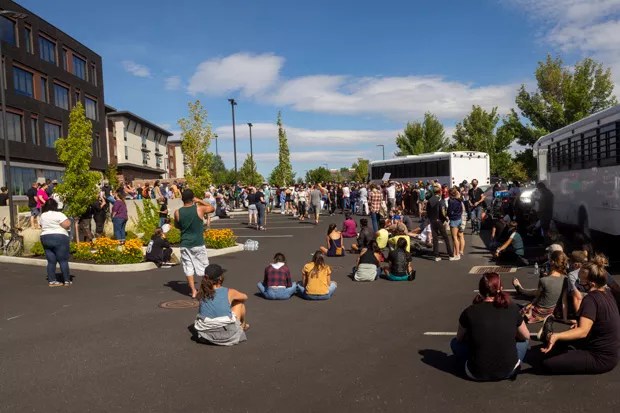
On Aug. 12, hundreds of locals showed up in hopes of preventing U.S. Immigration and Customs Enforcement officers from departing Bend with two undocumented men who ICE alleged were a threat to the public. After several hours of protest, federal agents forcefully intervened.
“This isn’t the first time they’ve showed up,” Wendi explained. “They’ve been here several times; this was just the first time it became big news. One of the biggest issues with ICE being in Bend this time was that two large unmarked buses were not necessary to pick up two people; really, this could’ve been handled by the police department rather than a federal entity. There were lawyers present requesting warrants; the officers refused to read these men their rights. Anyone else being arrested has those rights, that’s part of the freedom, part of the greatness of this country. When the federal government oversteps their boundaries and doesn’t follow procedures or reinforce the protocols that are meant to protect and serve, then it becomes a political issue.”
ICE officials, aware that information about the seizure of undocumented individuals is often misunderstood, shared this with the Source from its website:
“ICE enforcement functions do not need a judicial warrant. The ICE officer will utilize administrative removal warrants to carry out their duties. It is important to keep in mind that the underlying basis for a non-citizen’s removability may be due to some criminal violation, but the removal warrant used by ICE is not a criminal warrant signed by a federal judge. The removal warrant used to process the non-citizen’s removal is signed by an ICE official based on a finding that the person is removable from the United States.”
Bernabe noted that when ICE arrived in Bend, fear quickly bubbled to the surface.
“My partner and I are both DACA recipients; we had a conversation before the protest that we might need to prepare for ICE to grab us, too,” she said. “It was a nightmare. It’s still a nightmare. I’m anxious, I’m paranoid. I have to think, ‘What could happen to me today because of my skin color?’ This is our daily life. We don’t know if we’ll walk out onto the street and be taken by our government. It isn’t just the Latinx community, but the Black community, the white community; we are all living in this bubble of fear, anxiety and uncertainty. Trump brought division upon the U.S.; now it’s turned into an ‘us versus them’ kind of thing. I started to believe that in my own head. After Trump said something negative about Mexicans I would go to a restaurant and look around to see who was staring at me. I started to believe that division was here in Bend—until I showed up on Wednesday. To see that the community showed up to support racial minorities was amazing.”
Both women encouraged locals to exercise their right to vote—a right they do not yet have.
“Having the local community stand up for these two individuals made a pretty good point,” said Wendi. “It’s important that community members keep this message in mind come November.”
Bernabe concluded, “I can’t vote; I would love to vote,” she said. “The elections of 2020 mark my future. The future of my community.”
This article appears in Aug 19-26, 2020.
MAKE LOCAL JOURNALISM HAPPEN




Thank you for writing this article and thank you to the participants of the article and being Brave to tell your story. We need to hear your stories. The vigil last night at Drake Park was beautiful and thank you to all of the Latina/o community for being a part of our community here in Bend and the diversity and rich culture you bring to the table. I appreciate you and will advocate for you. Please everybody, you have a voice, use it! Please dont be silent during these times. Take action and advocate for diversity and culture and at the very least VOTE! We need to restore sanity into our nation. We have to all take part to be a whole again.
It would have been helpful if the reporter had asked if those interviewed were indeed DACA authorized here in the United States. For example, did / do they meet these requirements as put in place under former president Obama.
Otherwise this is a very nice story but devoid of both confirmed facts and educational information readers may find interesting / helpful.
“What are the eligibility requirements for DACA recipients?
“Applicants to DACA have to be:
“At least 15 years old when applying but under the age of 31 as of June 15, 2012
Under the age 16 when entering the United States
Living in the U.S. continuously since June 15, 2007
Present in the U.S. on June 15, 2012, and at the time of applying
In school or have graduated or completed high school, or have been honorably discharged from the military
Not convicted of a felony, a significant misdemeanor or three or more other misdemeanors
DACA applicants also can’t “otherwise pose a threat to national security or public safety,” according to the U.S. Citizenship and Immigration Services. They couldn’t have lawful status on June 15, 2012, either.
“The requirement that applicants be at least 15 years old when applying is waived for those who are in removal proceedings or had received a final removal or voluntary departure order. They can’t, however, be in immigration detention.”
Further –
“The DACA program doesn’t provide a path to citizenship, and even though recipients have deportation deferred, they still do not have lawful status. However, about 40,000 former DACA recipients did go on to get their green cards, becoming lawful permanent residents. How? A spokeswoman for USCIS, Claire K. Nicholson, confirmed to FactCheck.org that the 40,000 people used what’s called “advance parole,” under which DACA recipients could get permission (after applying and paying a $575 fee) to travel abroad for humanitarian, educational and employment purposes. Once they returned to the U.S., they were entering the country legally. Typically with unlawful status, an immigrant would have to return to his or her home country and apply for a green card there.”
https://www.factcheck.org/2018/01/the-facts-on-daca/
Greg — Not sure why you need that confirmation, but yes, the two mentioned here have received legal work status under DACA. It says it right in the article.