

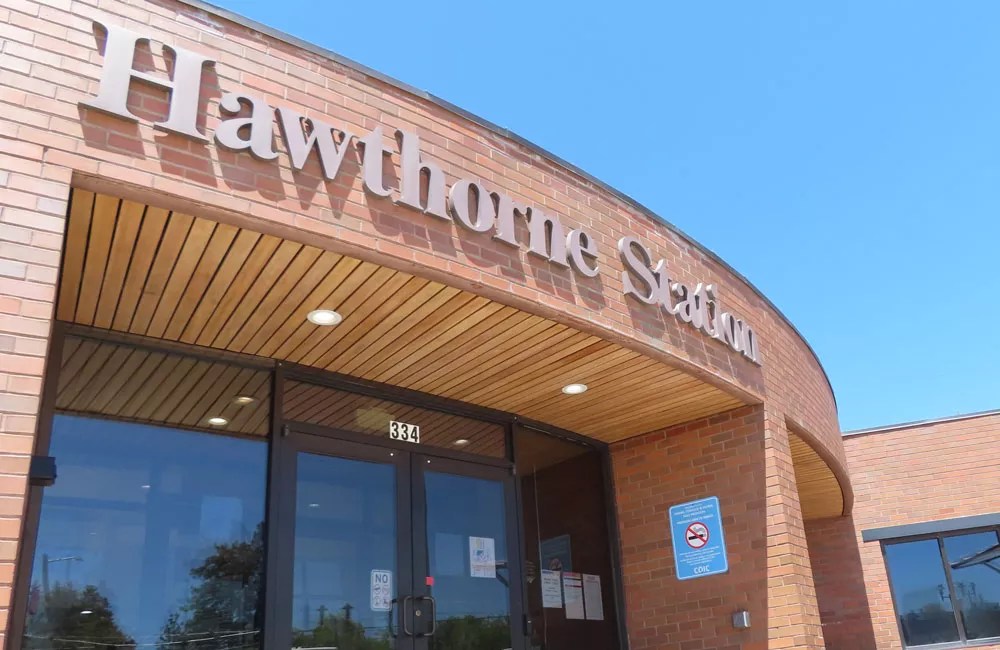
The Cascade East Transit bus trundled along Route 2 past downtown Bend during the evening rush hour on June 12. Finished with work, Jill Hanson boarded the bus at Hawthorne Station, choosing a window seat among four other passengers. Hanson has ridden the bus since her car broke down in February. She tried bike commuting but opted for the bus after she slid on black ice and crashed. She learned about the CET’s expanded summer hours from a flyer a bus driver had given her. The wider service window lessens her stress getting to work each morning, she said.
“Before, I was getting to work five minutes late,” Hanson said. “I’m really thankful for the new hours.”
Last week, between June 2 and 9, the CET trotted out its Try Transit Week campaign, geared to gin up public interest in taking the bus instead of driving. The week was also the first of the expanded summer schedule. According to CET, riders responded, clocking in 1,000 more rides during Transit Week than they did the same week in June 2024.

Still, as CET director Bob Townsend explains, some riders were surprised to realize that free bus rides weren’t an enticement during Try Transit. CET hasn’t charged fares for non-recreational rides since 2020.
“Clearly, we haven’t been doing well with awareness, since transit’s been free the whole time,” Townsend said.
Try Transit Week comes before the CET’s expanded operating hours along its 11 fixed routes in Bend. With the summer schedule, the day’s first bus will leave Hawthorne Station at 6 am; the last bus will depart at 7 pm. These services changes, which happen twice a year, allow CET to keep what’s working — and adjust what’s not.
More than anything, CET leadership is trying to do their part to help alleviate congestion in Central Oregon, which has been a growth leader in the state for years.
Fares on the in-Bend, fixed routes will be free until autumn, when they’ll tick up $2 per ride. That said, 75% of CET riders will qualify for a reduced rate that brings that $2 fare to $1, according to the agency. CET will also introduce a monthly pass, which will save money for folks who take the bus 20 times or more each month. Bend residents who can demonstrate eligibility as disabled, low-income disabled, or as a low-income senior, will be charged $4 for each Dial-A-Ride trip. Outside Bend, Central Oregonians can still access the $4 Dial-A-Ride service, but do not need to demonstrate any eligibility — it’s for anyone.
The most-popular routes, and the ones that pay for themselves, have been the CET’s recreational routes, such as Ride The River — which allows river floaters to use a bus shuttle service — and Transit to Trails, which offers rides to Mt. Bachelor Resort and sno-parks along SW Century Drive. Ride The River will bump its fare from $4 to $5; the Lava Butte route will tick up from $3 to $4.
(A complete list of changes is available on the CET website.)
CET has offered free rides on non-recreational routes since 2020, when the COVID-19 pandemic, with its residual layoffs and the ability for others to work from home, dwindled CET ridership. Since then, amalgamated ridership has rebounded past pre-pandemic numbers.
In 2019, CET gave 595,260 rides across all transportation services. In 2020; 359,754 rides were counted that year, dipping to 163,934 in 2021. In subsequent years, ridership rebounded, with riders logging 659,692 trips in 2024. CET didn’t immediately have any official ridership reports for 2025.
Analyzing Drivers’ Pay — a Peek Under the Hood
While CET has continued expanding its services since COVID, employees who are members of the Amalgamated Transit Union Local 757, such as CET drivers, dispatchers and mechanics, have voiced frustrations about consistent low pay. They argue the low pay still doesn’t afford them a living wage — nor does it track with inflation and hikes in health insurance premiums, they told the Source in April. This, they say, has explained recent years’ high turnover rate among employees, particularly bus drivers.

Bob Townsend, the CET director, said that the retention problem has since been addressed, if not completely fixed.
On June 1, a ratified agreement between COIC and Local 757 went into effect; concessions included a 6.49% pay bump to the starting wage for CDL drivers and a 3.5% increase for all other classifications. Current CET job openings include a vehicle mechanic in Bend ($26.74/hour) and a CDL transit bus driver in Redmond ($25.75/hour).
That’s up from April 11, when the CET job board listed a dispatcher position ($21.22/hour) for a dispatcher and a full-time CDL bus driver ($24.18/hour).
Townsend said the increased wages, along with benefits, are comparable to other local employers such as school districts. Bend-La Pine Schools advertises driver positions beginning at $25/hour. That’s a point of distinction; the Local 757 officials cited the school district’s better pay leading up to its bargaining session with the COIC on April 11.
Townsend, who joined the CET in September 2024 after nearly 23 years at the Oregon Department of Transportation — most recently as the Lower John Day & Central Oregon area manager — said he feels good about the pay raises won by CET’s unionized workers.
“I think we’re moving in the right direction,” said Townsend, adding that it may be too soon to know whether the pay bump solves the retention issue, which he says has improved in the past six months.
Still, some newly hired drivers might not be up for the inherently demanding job, he says. For example, Bend police responded to an April 28 call regarding a man who boarded a CET bus at the Hawthorne Station, allegedly impersonating an ICE officer and questioning passengers about their immigration status, the Source reported on May 28. CET drivers operating between Warm Springs and Madras have also dealt with harassment and violence among passengers, Townsend confirmed.
“Say we get a driver in. They think it’s going to be one thing. They don’t want to work the weekends, but we have routes that cover the weekends, so maybe that’s why they left,” Townsend said. “We get people in from the school district because bus drivers have split shifts where they work in the morning and afternoon. A lot of people don’t like that, so we get some of those drivers.”
Thomas Tsuneta, the union’s liaison, says the pay bump for drivers is progress, but not enough.
“We didn’t feel this was fantastic, but a deal that we believe the membership will likely vote for,” Tsuneta told the Source on April 11. “With 17% inflation over the last three years alone, we’re still way behind the actual increase in the cost of living.”
A Disparity in Pay
A Source analysis of COIC financial reports concluded that CET employees, such as drivers, dispatchers and mechanics, have received, roughly, a 5% annual wage increase since fiscal year 2018-2019. During the same period, the Source noted a roughly 9% annual salary increase for administrative and managerial employees of CET and COIC, including the COIC executive director, deputy director, human resources manager and CET director.
Those administrative and managerial salaries compare to those earned by the Lane Council of Governments, which serves Linn and Lane counties and participating municipalities — twice the population of Deschutes and Crook counties. Intergovernmental councils in Oregon do not have salary caps; the only financial control involves pension calculations. Unionized CET employees have a capped pay raise structure, yet future bargaining agreements can raise those caps.

Still, the partnership between CET leadership and Local 757 leaders and other CET staff gives Townsend confidence, after recent years marred by COVID-era low ridership and corresponding layoffs, reduced hours and high turnover among CET’s lowest paid employees.
“I think we’re kind of turning the corner,” he said. “We’ve been in this triage, this reactive mode. Whereas now, we’re being proactive.”
Presently, 40 CET drivers operate in Central Oregon, with 20 drivers operating through MTM Transit, the CET’s private contractor, on fixed routes in Bend. Recent grant money from Western Federal Lands and Oregon Payroll Tax allowed CET to order more buses — its most pressing concern, Townsend said — but they’re back-ordered by 12 to 18 months. CET counts about 80 buses in its current fleet.
At the Mercy of Federal Forces
Deschutes County Commissioner Phil Chang has a pretty good long view of the CET’s financial situation. Chang, who also serves as a commissioner for ODOT, spent nine years at COIC, (yet in a role that did not involve public transit). He noted that the money CET receives through COIC, like all intergovernmental councils, is funneled from federal, state and city grants. Sometimes these revenue streams run consistently; other times, they get kinked by the political climate in Washington, D.C. The Trump Administration, for example, is presently reviewing a $3.1 billion federal grant that will help fund California’s construction of a high-speed, solar-powered rail system that would connect San Francisco and Los Angeles. Bob Townsend says he hasn’t noticed any federal interference to transit funding in Oregon, despite layoffs in the Department of Transportation and federal discussions around sanctuary state funding.
According to its budget report for fiscal year 2025-2026, COIC received $29.7 million in total grants and contracts. The federal government granted $6.75 million; $6.35 million came from the State of Oregon and $16.61 million came from county and city governments. During this time, bus fares — from the CET’s fare-charging recreational transit services, brought in just $662,200. With additional fares this fall, CET leadership hopes to generate more than $1.25 million, but with implementation costs and reduced rates, it will take more than a year to know how much these fares will reliably bring in.
COIC receives annual transit funding from the City of Bend. In the 2025-2026 budget report, there’s a placeholder amount of $1.643 million, but that money, which is matched with federal grant dollars, isn’t guaranteed. Townsend added that local contributions may be reduced if the statewide payroll tax receives the hike some transit advocates and lawmakers hope for.
That payroll tax, officially known as Oregon’s Statewide Transit Tax, is an integral funding source for CET and other public transit providers throughout the state. Since July 1, 2018, the tax has collected one-10th of 1% of employees’ gross wages; ODOT estimates that this tax will bring in $141 million this year. The Oregon Transit Association, a nonprofit association, supports HB 2025, a bill released on June 9 that includes a phased 0.2% increase in the employee payroll tax rate over five years, feeding the Statewide Transportation Improvement Fund. According to U.S. Census Bureau figures, that tax hike would amount to a little under $17 each month for a median Oregon worker who earns $44,063 each year.
Chang shares CET’s goal of offering wider and more frequent service for folks in Central Oregon, yet he appreciates the complex and inconsistent nature of its funding.
‘Skin in the Game’
But support for a robust public transit system in Central Oregon starts with everyday folks taking the bus. The expanded summer schedule is a good place to start.
“It’s making a deal, putting skin in the game,” Chang said, comparing the situation to a new restaurant that goes out of business if customers don’t show up. “If you want this service, then please show it.”
During the evening rush hour on June 12, Cole Younger Smith chatted with a friend while riding the CET’s Route 2. He sipped from a CET-branded water bottle and a Try Transit Week button peeked from the side of his backpack — the promotional swag he picked up riding his normal routes. But Smith didn’t need any nudging to take the bus, he said; he’s used the bus for his daily commutes since 2022. Riding the bus saves him money he’d otherwise spend on car upkeep and insurance. In comparison, the new fares the CET will re-introduce this fall are nominal, he said.
Chatting with a reporter, Smith realized he’d left his cell phone at a downtown church, where he’d just been. That worried him until he realized that, with the CET’s extended summer schedule, the bus would run long enough for him to complete the looped route, retrieve his phone from the church and still be able to catch a ride home with the bus before it was parked for the night.
“I love riding the bus,” he said.
—This story is powered by the Lay It Out Foundation, the nonprofit with a mission of promoting deep reporting and investigative journalism in Central Oregon. Learn more and be part of this important work by visiting layitoutfoundation.org.
This article appears in Source Weekly June 19, 2025.
MAKE LOCAL JOURNALISM HAPPEN


I’ve lived here for eight years. The next time I see a CET bus will be the first time.
Why are rides free but if you want to take a river shuttle, which is a short distance, you have to pay $5?
Note to workers who are asking for a wage increase due to inflation. You are, in fact, contributing to inflation with your wage increase. I’m not suggesting you don’t deserve an increase, but you might want to come up with a better reason, e.,g., pay for performance.