


In winter, those who venture up the Cascade Lakes Highway (aka Century Drive) to Virginia Meissner Sno-Park or beyond may not consider how much blood, sweat and tears go into making that possible. However, the Oregon Department of Transportation is acutely aware of what’s involved, especially those workers who lose precious sleep ensuring that the rest of us can zoom up Century Drive whenever we choose.
Supported by a host of mechanics, machinists, dispatchers and office workers, heavy-equipment operators with their plows, snowblowers, graders and front-end loaders wage the actual combat, often in the most vexing conditions.

“Not everyone can operate a snowplow,” says Rob Cox, one of ODOT’s road maintenance supervisors in Bend as he eases his massive 10-yard dump truck and plow through rush-hour traffic. (Century Drive’s two mountain trucks can carry only four yards of gravel, leaving more muscle for plowing.) “Many assume it’s a snap, until they give it a try. Some quit after a single test drive.” After my ride-along to Mt. Bachelor, I can relate: The jostling reawakened every old insult in my nervous system, leaving me shaken.
While many of us view a drive to Bachelor as an outing, it’s always serious business for the plow operators. “Driving a snowplow is mentally taxing,” says Cox. “In addition to the road and traffic, the driver has to pay attention to as many as three plows (head, belly and side) and the sander. Maximum speed for plowing is 35 mph. Any faster, and the plow leaves a wavy surface nobody enjoys.”

“Left to right. We move snow from the center line to the shoulder. When we can’t see the center line, we keep our left front tire on the rumble strip. The vibration tells us we’re on it,” Cox explains. “When you see the plow coming down the center of the road, we’re not playing chicken — we have to be there. Opposing traffic can help by slowing down and giving us some room. If they keep a steady line, all will be good.” During blizzards, drivers may not be able to see past the hood of their trucks. “When we can’t see from one snow stake to the next, we call that ‘plowing by braille.'”
Just beyond the Sunriver junction, a knee-high pile of snow remains on the shoulder. When Cox drops the blade, the curved plow sends a 14-foot-high vortex of slop up and over the top of the embankment. ODOT crews don’t stop at merely exhuming the roadway from each snowfall. Instead, they push the snow back to the far edge of the outward sloping shoulder where it meets the orange marker poles. Besides creating temporary storage space for the next dump, this minimizes the possibility of melt reaching the pavement where it might refreeze and send some feckless driver careening into a snowbank or oncoming traffic. That’s love.
Doing More, With Less
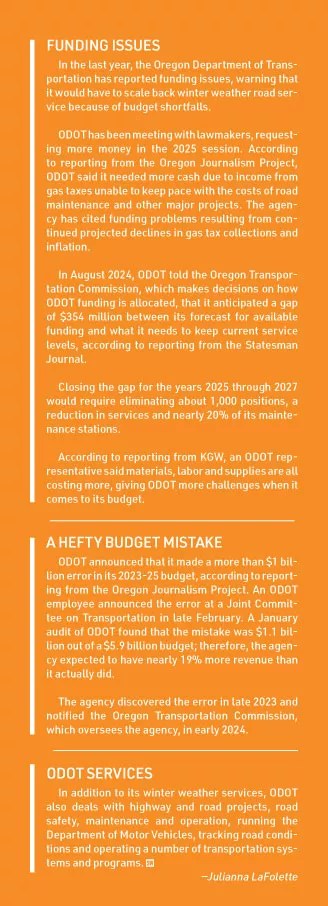
Currently, ODOT’s Bend base has 17 operators, down from 25 a few years ago, thanks in part to declining fuel tax revenues. In addition to Century Drive, however, the base is also responsible for Highways 97 and 20, and Greenwood Avenue in town. Keeping Highway 97 open is their top priority, but “our drivers take a great deal of pride in making Century Drive as safe as possible because friends and families use it every day,” says Cox, who skied Bachelor more than 100 times a season in years past and still snowmachines.

Normally, operators drive four 10-hour shifts each week. But storms can stretch shifts to 12 hours or more. “Whatever it takes,” says Cox, adding that during the big storm cycle over the Christmas holidays, everyone volunteered to work overtime to keep the roads open.
On Century Drive, ODOT’s responsibility extends 17 miles from the Deschutes National Forest boundary just past Tetherow to the West Village access road just past Dutchman Sno-Park. (Hence the sometimes-dramatic change in driving conditions at both ends.)
And there’s more. While the roadway is the priority, ODOT’s Forest Service contract also requires clearing seven sno-parks, including Kapka and Edison. As the parks are heavily used during the day, ODOT tackles them at night. While overnight parking is illegal in some, that doesn’t stop anyone. Indeed, the parks are rarely completely empty, thanks to folks camping in their vehicles or outside on overnights.
When they don’t have to maneuver around too many private vehicles, two men with a grader and a blower can clear eight inches of new snow from the smaller parks in about an hour. Ditto the Sunriver junction, which can only be safely cleared at night on account of the constant stream of daytime traffic. Larger sno-parks like Wanoga and Kapka take twice as long. Therefore, clearing just the sno-parks can easily consume two entire 4pm to 2am night shifts — and that’s with only eight inches of accumulation. During big storms, by the time ODOT gets to the sno-parks, they may be buried in several feet.
Wanoga Beaut

ODOT’s satellite facility atop Wanoga Butte includes sand and fuel sheds and a heated garage for the blower and grader. Weatherwise, the butte is a beaut. During 22 years with Bend ODOT, Dan Ramsey has seen Wanoga roofs blown off twice. With no door on the sand shed, snow often swirls in, dusting the loader and cementing loose sand into boulders.
One of the most unpleasant tasks is refueling since drifted snow often clogs the entrance to Wanoga’s fuel shed. As shifts typically start in Bend with a full fuel tank, refueling, should it be necessary, tends to occur near shift’s end. Just to access the pump’s on-off switch, hose and nozzle, a tired operator must abandon a warm cab for 20 minutes of shoveling through a four-foot drift, often in biting winds or howling blizzards.

Creeping along at 3 to 5 mph, Wanoga’s massive snowblower can augur through a 12-foot-wide, five-foot-deep swath of snow and shoot it a couple hundred feet beyond the 10-foot-high berms along the roadway at Mt. Bachelor, making room for future snowfalls. Operating the blower requires exceptional skill and endless patience.
“You can’t push it,” Ramsey says. “It takes a certain kind of person. We have several who are able to maintain an unwavering berm edge. Rob is one of them.”
Like Cox, Ramsey is an avid snowmachiner when schedules allow. As for why he’s still at it after 40 years with ODOT, Ramsey says: “I just like working in snow and playing in snow. It takes a lot of work to make that road safe.”
The rest is up to us motorists.
Related Stories

ODOT’s Alternative to the Gas Tax Is Stuck in Neutral
This article appears in The Source Weekly March 20, 2025.
MAKE LOCAL JOURNALISM HAPPEN


It is disheartening when people complain about roads not being clear or the pace of travel when following snow plows and cinder trucks. The article provides an an excellent vision for the work these men and women do in keeping our roads open and safe. Their dedication to their craft is amazing!! Thank you Mike Macy, your story will hopefully give the complainers a reason to be thankful for the job ODOT personnel do, so we can recreate in our beautiful outdoor environment.
Thanks for plowing all of our Sno-Parks! Winter recreation wouldn’t be possible much of the time without ODOT’s plow operators.
Great article about the plows and those who operate them. I would add, I believe 80% of snow driving is on the public. If you are living in the area, get snow tires! One tow truck bill from a spin out or deductable from a crash, will pay for the tires. Just get them! Please.