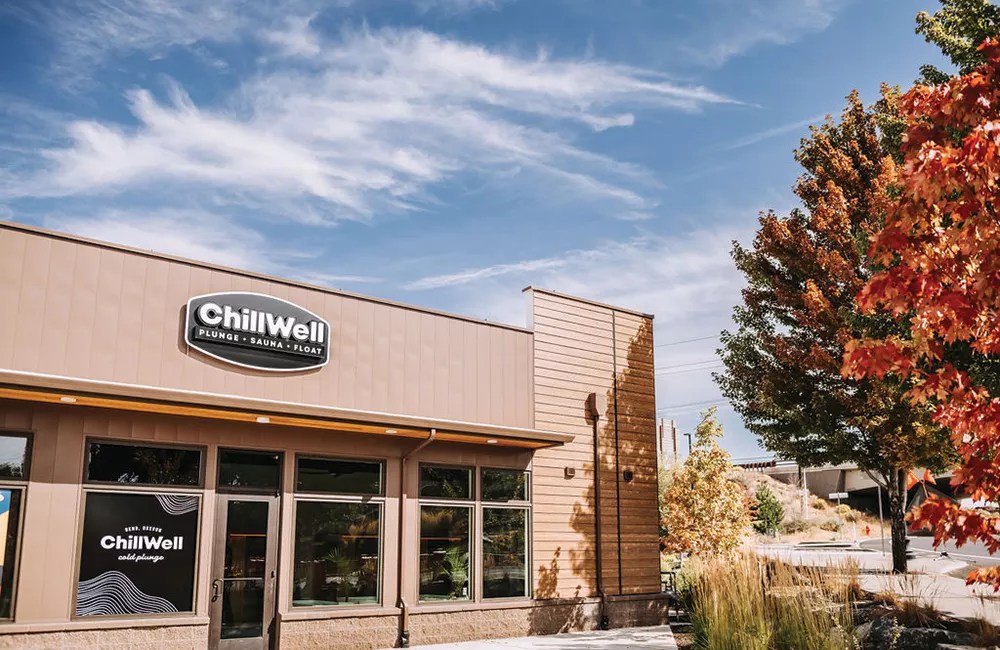
The start of a new year brings resolutions aplenty. Among the top for many is focusing on health by eating cleaner and moving more, but a recently opened spot in Bend offers a lower bar to entry for health and wellness — floating away built-up stress, anxiety and troubles one hour at a time.
ChillWell opened last September as an expansion of a concept that owner Bryan Messmer first launched in 2018 with his float pod-only business, Easy Float. Since then, the company has rebranded as ChillWell and expanded its offerings to include infrared saunas and cold plunge tubs. And while Messmer is planning on adding more services — an outdoor barrel sauna is coming in the next few weeks — the float pods that brought him into the health and wellness space remain a core part of his services.
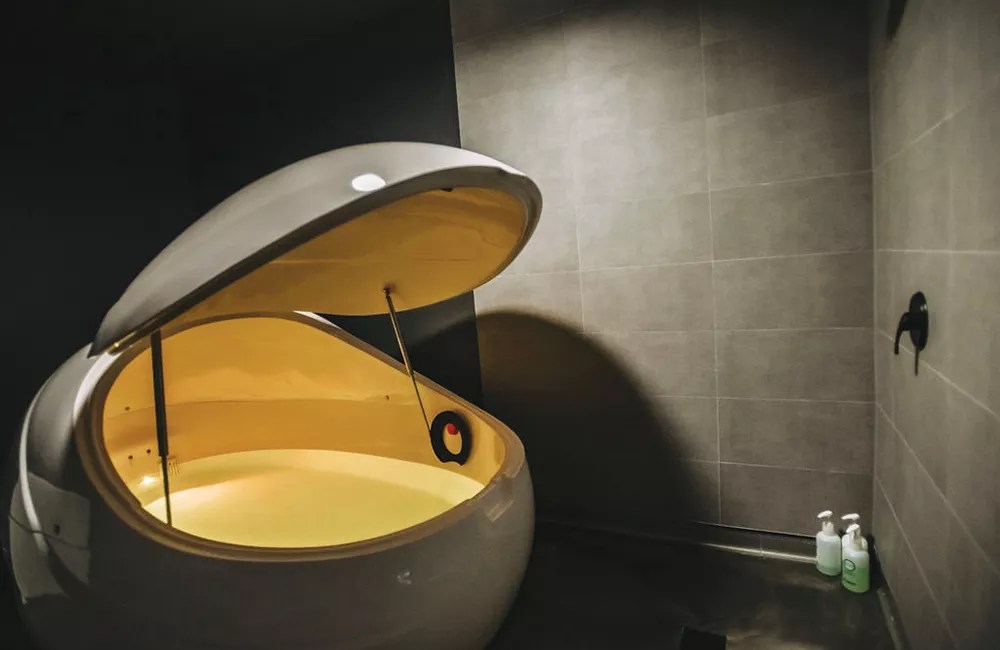
In a float pod, the tank is filled with just enough skin-temperature water for a person to float (around 10 inches deep) and enough dissolved Epsom salt to create a cradling buoyancy for the user. The tanks at ChillWell are smooth white, egg-shaped vessels that recall sci-fi space pods. A large latch at the top allows for easy entry and gives the floater control over how much light and sound they want to allow in the tank with them. Closing it all the way and turning off the interior light will seal out nearly all light and sound. That, combined with the water temperature and complete buoyancy, turns down, or off, the user’s senses. The aim is to surrender to the float and in so doing enter a hypnagogic state, or the threshold of consciousness — the transitional phase from wakefulness to sleep.
A 2023 report out of the University of California, Merced, analyzed existing research on floatation tanks, first invented in the mid-1950s, and found that: “Many studies have shown this technique to be beneficial in treating ailments such as anxiety, chronic pain, and other conditions associated with stress and muscle tension.”
Quoting one study’s results, the report said, “a single one-hour session of Floatation-REST was capable of inducing a strong reduction in state anxiety and a substantial improvement in mood in a group of 50 anxious and depressed participants spanning a range of different anxiety and stress-related disorders.”
It’s a dreamy promise, one that I — a mom of two young children and a full-time reporter for this paper — was eager to test out at ChillWell, the only commercially available floating option in the area. My slight discomfort with enclosed spaces and (ahem) very minor control issues aside, what was there to lose?
Messmer said he first tried floating over a decade ago to help improve his sleep.
“I could fall asleep, but I couldn’t stay asleep,” Messmer said. “Like clockwork, every morning I would wake up at 3am, and floating made the biggest difference. I tried a bunch of different stuff to try to better rest, but a float tank made such a huge difference.”
He quickly turned from skeptic to believer and has helped others experience the benefits of floating. Among his repeat clients, Messmer said, are people managing stress and anxiety, recovering from traumatic brain injury, dealing with post-traumatic stress disorder and training for endurance events.
“It is pretty approachable,” Messmer said. “It’s meant to be relaxed, like, all recovery, no fitness.”
Setting my reservations aside and holding on to the promise that one hour of doing nothing would help me feel more relaxed and less stressed, I visited ChillWell in December for a float.
Inside, the spa is clean and modern. The main area holds the saunas and plunge tubs, and a narrow hallway to the left is where the two pods are housed in private rooms. Check-in was brief; I was instructed to rinse off well before to avoid contaminating the pod with lotion or conditioner and was also provided earplugs so I wouldn’t end up with ears full of Epsom salt. The attendant gave me some basic instructions about safety and how to control my experience by choosing to keep the interior light on, closing the latch to my preferred spot and using a foam disk under my head if I was having trouble relaxing my neck and trusting the water’s buoyancy. Then I was left alone.
Upon entering the pod, I initially found the skin-temperature water disconcerting. The act of feeling nothing is hard to get used to. But, I was committed to the full experience and so I swiftly laid down, turned off the light and shut the latch, launching myself into blackness and silence. Within moments, I was spinning in circles.

OK, not literal circles. While the pods are spacious, they’re not wide enough to accommodate 360s. However, the immediate feeling I had was like a compass needle trying to find north. Absent sensory input, my brain was lost. I grasped around for the light and managed to find it quite easily. Turns out I was not drifting in space, and it was still an inch or two from my hand, but I cracked the latch for good measure.
Over time and with experimentation, I did find some calm during my hour-long float. Leaving, I felt the kind of deep relaxation I usually associate with a good massage. I did not enter a hypnagogic state or experience any revelations or hallucinations; I did sleep better that night.
Weeks later, on a call with Messmer, he said, “We have a joke in the industry: If you’ve floated once you haven’t floated.”
He said that though it may sound self-serving, it’s important to float multiple times to get the full experience — hence the monthly membership that discounts a float from $69 an hour to $49 for one float a month.
Messmer acknowledges that it isn’t for everyone and that even he “falls off the wagon” sometimes.
“I’m a once-a-month floater until I fall off my New Year’s resolution somewhere around June,” he said. “This is the year where I’m going keep doing it,” he added, with a laugh, “because I know every time I do it, I think, ‘What took me so long to get back into this?’ Because you leave feeling just better.”

This article appears in The Source Weekly January 9, 2025.
MAKE LOCAL JOURNALISM HAPPEN