


This weekend, a member of the Bend City Council will once again meet a group of concerned citizens in Drake Park to answer questions about the City of Bend’s proposed shelter code changes, its approach to managed camps and more topics concerning homelessness in the city. The meeting was brought on by a group of people who have used the social channel NextDoor to ask questions and share concerns. Some of those same people say they’ve attended Planning Commission and City Council meetings to try to understand what local leaders are doing. Some have expressed frustration that the few minutes afforded to residents to speak during these public meetings has not been enough to have their message heard—and hence, why they’ve relished the idea of having City Councilor Megan Perkins give them extra time.
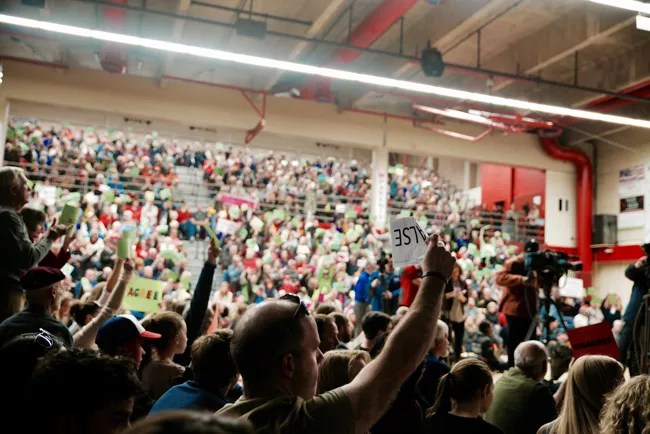
While it’s noble of Councilor Perkins to spend part of her weekend to meet these vocal locals and to hear them out, this reminds us of a better tool in the public toolbox that would better serve the larger community: the public town hall.
During the last version of this meeting in Drake Park, some reported that it was nice to have more time to share what they’re thinking. Others reported that it was less than productive to have dozens of people attempting to speak over one another all at the same time.
While we admire Perkins for her attempts, it all begs the question, why not formalize these meetings? We agree that it can be anticlimactic to get only three minutes during a City Council session (still held online, to the frustration of many) to express what someone might otherwise spend all day reiterating to a smaller and more excitable group on NextDoor.
The chasm is wide between a Sunday meeting in Drake Park with one councilor to a bona fide public meeting that adheres to Oregon’s public meetings law. At its most basic, public meetings in Oregon are defined as, “any meeting conducted by a state, regional or local governing body to decide or consider any matter.”
There is no doubt that on this topic, with things like the construction of managed camps near schools and homes in question, people want to be heard.
These meetings include public notice requirements, requiring the public body conducting the meeting to adequately inform the public about the time, place and agenda of the meeting. While it’s lovely to see a city councilor really trying to help people understand the full picture of the homelessness crisis in Bend, the effort would be better executed were more people—and not just those who can wade through the chatter on social media—be alerted to such things. During a more formal meeting, parameters are set around discourse: who can say what and when and for how long. Some might like a filibuster-like opportunity to share their views, but in the interest of us being in this together, there has to be a happy medium between three minutes and unlimited debate.
A formal meeting would also allow more of a given publicly elected body, in theory, to attend. Having a majority of an elected body present is a quorum, which triggers the requirement for public notice and the ability for the public to attend.
Some intending to attend the meetings in the park have seen the lack of a quorum as a good thing, because it means less formality and fewer requirements put upon them. But we view it as the opposite: It means fewer people will be informed of the existence of such meetings, potentially leaving out voices that may be essential to the conversation. A town hall also allows attendees to hear from voices outside their political bubble. This aspect should not be underappreciated. The public meeting provides an opportunity to air differing viewpoints in a safe and controlled environment—something that has been sorely lacking during the past two years.
There is no doubt that on this topic, with things like the construction of managed camps near schools and homes in question, people want to be heard. Throughout this time of endless online meetings, people have not had that opportunity as in the recent past, and that’s manifested in a general sense of dissatisfaction. Now, with the mask mandate lifting by the end of March, and with our community embarking on the notion of “a return to normal,” we feel it is time to make discussions like these less ad hoc and more formal.
The time is right for the City to stage a series of town halls to let people release their collective political pressure valves. The alternative, in our eyes, is to see the same discussion continue to devolve on social media, witnessed by many, to the benefit of very few.
This article appears in Feb 17-23, 2022.
MAKE LOCAL JOURNALISM HAPPEN


They dont want open forums that means theyd have to be transparent.
If you read between the lines all the rezoning isnt just about homeless campgrounds, its all about the power to build on every piece of dirt anything they want in Bend without getting any push back, How to silence people and push your narrative, nobody in their right mind wants a homeless camp in their neighborhood full of mental ill/drug abuse/alcohol abuse/vagrants/panhandlers/beggars
And thieves.
This is intrusive, and for them to even push this shows you cant fix stupid.
I can bet you not one city Council member ever had a homeless campground in their neighborhood when they were growing up, because it was Law and order and it was not allowed, they were vagrants, And public nuisance
Megan Perkins’s Drake Park meeting proved to me that this city is crying out to see and hear, in person, our elected councilors as well as the City Manager and the Chair of the Planning Commission. Hiding behind controlled Zoom meetings is not governance; it’s hiding! Just like “Hide and Seek” that we played as kids …
I heartily welcome public town halls, in-person, full City Council hearings on the proposed homeless shelter code. The changes are sweeping and will impact Bend greatly. I do push back on the framing here that public participation in the months of City online meetings around homeless solutions and HB2001 (infill housing) was limited to a “more excitable group”, those “who can wade through the chatter on social media.” Every citizen with an internet connection had equal access to City meetings. Those sufficiently motivated acted.
Which actors were clamoring to be heard? Mostly homeowners from older Bend neighborhoods without the CC&R protections other areas of Bend enjoy. These “excitable” taxpayers know that lacking CC&R protection, homeless shelters will disproportionately land on their streets and in their neighborhoods and will disproportionately affect their home equity, their livability and their kids’ safety.
If ALL Bend neighborhoods were subject to the City’s proposed shelter solutions, no doubt “the larger community” would have been clamoring to be heard on Zoom, too.