


I’m with photographer Nancy Floyd in Old Bend on Congress Street, lined with trees fronting stately homes dating to the early 1900s. As part of her long-term project “For the Love of Trees,” she’s focusing on a ponderosa pine lofting above all others. The upper trunk arcs slightly to the northwest. The long branches swirl on all sides like arms akimbo. Every needle on the tree is dead. Only recently did the great tree succumb. Across the narrow street is the stump of a smaller companion cut down several years earlier.
Pygmy nuthatches flit among the limbs as I watch Floyd aim her camera. She is practiced, focused and spontaneous as light shifts and the shadow of a branch curves over the plated bark. While I’m taking notes and she is clicking photos, first one curious neighbor and then another come out to join us.
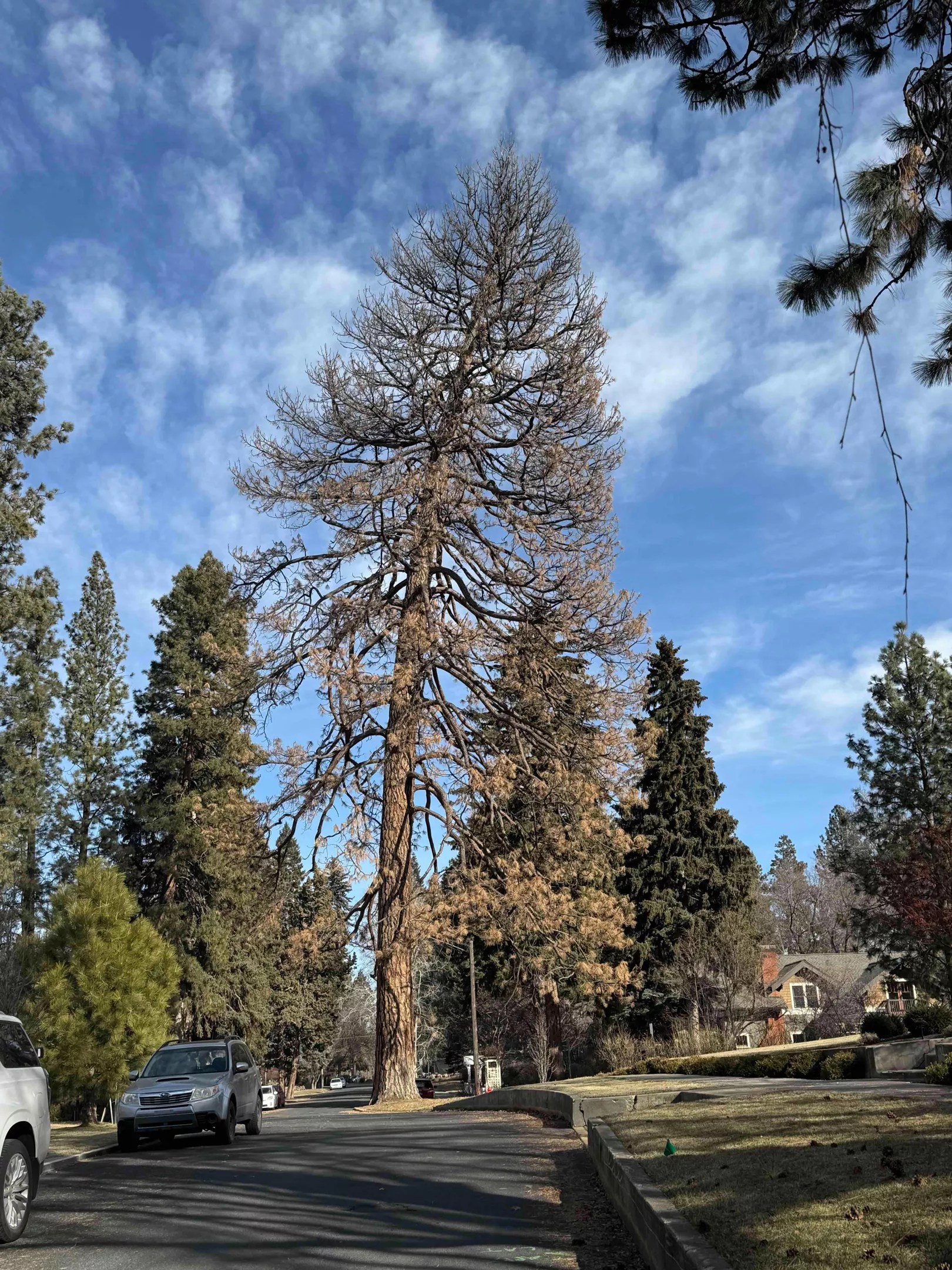
Hildur Schmidt tells us she had been sending silent messages of love to the struggling ponderosa last fall when some 200 crows began streaming in at dusk to roost in the tree that had begun to die from the top down. She wondered if the crows had answered her. In mornings, she would walk beneath the tree and pick up a feather or two in gratitude.
Scott Graaf is nodding in agreement, noting that never had they seen crow flocks come to their street and to that tree. “It felt like a reverence of crows,” he says.
As we cluster not far from the tree, cedar waxwings give their high-pitched “seet seet” calls. There are robins, flickers, chickadees, finches and nuthatches. We feel ringed in their music and a kinship with trees. But the days are numbered for the ponderosa to remain standing and life-giving to woodpeckers, owls and all who would come here. The tree will be cut down and the street, houses and people will be safer, and neighbors will feel the loss.
“If I lose my house to fire or something else, I can rebuild,” Graaf says. “But if a 100-year or older tree falls, I can’t replace that.”
While on the surface it might appear the centuries-old pine died strictly from lack of water, the tree’s fate was likely set long ago when the city widened Congress Street around the pine. When I sent a photo to arborist Avery McChristian, he pointed to the street almost touching the tree and pavement suffocating about 70% of the drip line (the outer edge of branches where rain falls and soaks in to feed roots that extend far from the trunk). Paving compacts the soil and damages roots, which can lead to pathogens entering through the wounds. Over time, the tree could not uptake enough water and nutrients to survive. While more watering likely would have helped, it would not have saved this vulnerable tree from what arborists call a “spiral of decline.”
Only a couple blocks away in Drake Park, Bend Park and Recreation District recently cut down a historic ponderosa pine after constructing a wide, paved bike path too close to the tree in 2023 and severely damaging the roots. I had joined a group of women in Feb. 2020 protesting the plan to log as many as 60 trees for the accessible trail close to Mirror Pond. We held a green ribbon protest, gained local media attention and saved some of the trees. “Don’t cut me down, go around” was our statement on the ribbons tied around each threatened tree. But going around means honoring the root system.
How much room are we willing to give to keep big trees standing, trees that give so much to us every day? They capture and store far more carbon than younger trees, offer shade and coolness in the record-breaking heat of climate change, and they are havens for birds.
Through Floyd’s creative lens, this ponderosa will live on in photography. With every click, she teaches us the meaning of the word “reverence.” There are lessons, too, in the power of neighbors and community coming together for their love of trees. Look around the place you live. What do you care deeply about? What will you do to show and share your love?
Isn’t it past time we paid attention to the intelligence of crows and the wisdom of ancient trees? Can one towering ponderosa in the city become a portal to the wild forests and lead to more people caring about threats from logging and the value of standing dead trees for wildlife? Many questions swirl into the roost from this one outing on a mild day at the end of January.
Why did the crows come to roost? Some questions are best left to the heart. I picture Schmidt picking up a black feather as she gazed upward into the whorl of branches.
Bend’s Marina Richie is the author of “Halcyon Journey: In Search of the Belted Kingfisher,” winner of the 2024 John Burroughs Medal for distinguished nature writing. Read her blog at marinarichie.com
This article appears in The Source Weekly February 6, 2025.
MAKE LOCAL JOURNALISM HAPPEN


Thank you. Wonder why all the vintage pines that developers were allowed to clear cut for Discovery Park and Discovery West development didn’t get much play?
Bend pretends to care about Ponderosa. They don’t. They care about cash.