I believe it was Ernest Hemingway who said that wine is one of the most civilized things in the world. From the vineyard grounds where grape varieties grow to the cascading effects of barrel aging, millions of wineries keep a watchful eye on the entire lee-filled process to ensure that each Cabernet, Pinot and Riesling delivers a complex and distinct flavor.
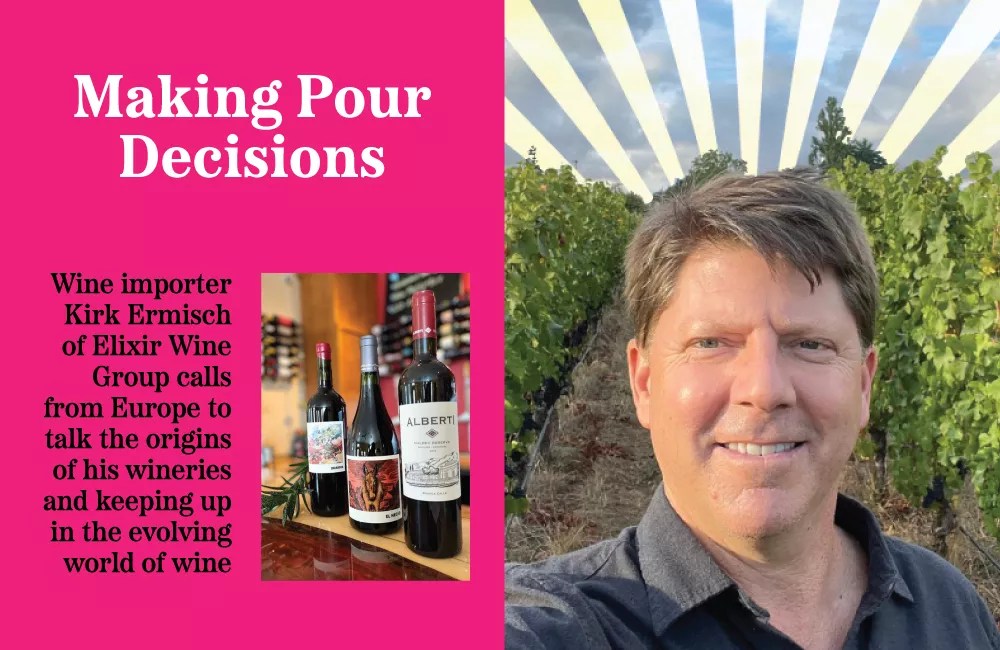
Elixir Wine Group, here in Bend, imports award-winning wines from South America, France, Italy, Portugal and more of western Europe while hosting an impressive wine bar/retail shop that is open six days a week. The Source Weekly spoke with owner and CEO of Elixir Wine Group, Kirk Ermisch, to get perspective on what it takes to keep the grapes growing and the glasses full.
*This interview has been edited for clarity*
Source Weekly: Starting off with Elixir Wine, what inspired you to jump into the wine industry?
Kirk Ermisch: We’re the oldest wine company in Bend, we’ve been here since 2000. I worked for a big Australian company and then worked for Kendall Jackson, a California wine company, and they sent me to Argentina where I built the first American winery in the country, that was owned by Kendall Jackson, so I started my own winery in Argentina before moving to Bend.
I started importing wine from South America, Argentina first and then started importing from Europe. We’ve been doing that for 22 years now and 10 years ago we started an Oregon winery and now we’re Deschutes County’s only winery, not just a tasting room. It wasn’t anything I fell into; it was a long story of 30 years.
SW: Are there any challenges to being a winery in the Central Oregon/Deschutes area?
KE: This won’t sound very nice but when a tasting room calls itself a winery and it’s actually just a tasting room, that can be misleading to people. Other than that, no, there’s no challenge being a winery in Oregon. Of course, you have to go through the correct processes and get all the approvals and that’s not easy, but we make wine from all over Central Oregon and a few from Northern Washington, we bring the grapes in and the wine turns out really good — no challenges.
“Of
course, you have to go through the correct processes and get all the approvals
and that’s not easy, but we make wine from all over Central Oregon and a few
from Northern Washington, we bring the grapes in and the wine turns out really
good, no challenges.”
SW: Having been in the wine industry for this long (30 years), how have you noticed the wine market evolve?
KE: Has it evolved? Sure, it’s evolved… in recent years, there have been more and more wine/wineries and we’ve kind of been at this production peak and that’s a good thing. But, it’s no longer a time of extreme growth with new labels, so for the small labels that are still around, all I can say is, hopefully,w they’ll be around for a while.
SW: How does your company stay tuned to consumer tastes and evolutions?
KE: We’re also a hotel importer and we own the winery in Argentina, we built this entire business from Bend and because of that we’re constantly traveling countries and traveling the U.S. We have salespeople that are selling our wine on the East and the West Coast, in almost all 50 states. We’ve got two warehouses; we work very hard and we are in a lot of small high-quality wine shops and restaurants with chef-driven wine programs and we’re constantly in communication with those people to stay up to date on trends and tastes.
SW: Last question, do you have a personal favorite on your label?
KE: No. We only buy wines that we really truly love and we only make wines that we think can compete with the best that we can buy. If we hold everything to that level, then we don’t have a favorite because every wine we buy or make needs to be absolutely perfect.
This article appears in Toast! 2024.
MAKE LOCAL JOURNALISM HAPPEN