Full spoilers below: Don’t read if You Haven’t Seen “You Can See Everything!“
Now that Nathan Fielder and Lance Oppenheim’s “You Can See Everything” has been out for a few weeks, I think it’s time to have a spoiler-filled chat about why it’s such a groundbreaking piece of filmmaking. Not sure if this is a hot take, but I have no real interest in Elizabeth Holmes or the whole Theranos saga, so my interest with “You Can See Everything” as a film has less to do with her than it does with the nature of documentaries, the modern malleability of truth and the absolute impossibility of actually seeing everything.
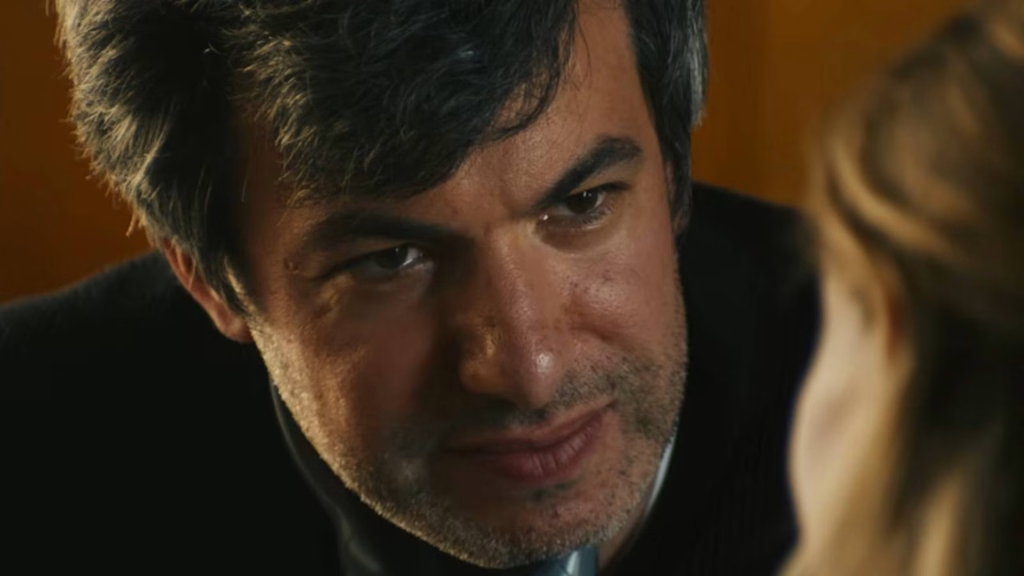
The film’s themes are quietly set up in the opening scene where we see a close-up of Holmes’ partner, Billy Evans, on the phone discussing her. He’s speaking for Holmes like she isn’t in the room. Like he is her voice now. Then the camera pulls back and we see Holmes sitting a few feet away, rocking her newborn baby. It’s like she has no agency whatsoever in her own life and is perfectly content to hear Evans discuss her like a chess piece rather than the mother of his children.
Throughout the movie we watch Fielder baffled by Holmes’ lack of agency. We see Evans convince her into letting an AI bot speak for her; to hand him full power of attorney and to allow him to tweet under her name. We also see a deeply confusing amount of unconditional love from Holmes toward Evans; something that feels like some unhealthy synthesis of Stockholm Syndrome and a Sub/Dom dynamic. We see all of this and still understand less than nothing about what actually makes these people tick. Did you finish the film thinking she was more or less guilty than before? Does it even matter?
Her innocence isn’t important. Plenty of unincarcerated people have committed way worse fraud than she has and simply bought their way out of trouble, so I don’t judge Holmes for the example the system has made out of her. What fascinates me is watching Fielder slowly lose all sense of objectivity regarding her, ultimately making a film that finds a mustache-twirling villain in Evans.
Once Holmes goes to prison, the film pivots into a piece of cinema that literally sheds the trappings of a documentary and instead interrogates if it’s even possible to make a non-fiction film beholden to objective facts when human beings are ultimately so unknowable. As the movie progresses, pay attention to the score, the camera set-ups, the color grading and the editing. Fielder and Oppenheim (along with editor Adam Locke-Norton and cinematographer David Bolen) structurally transform “You Can See Everything” into a pulse-pounding psychological thriller using the language of filmmaking. Suddenly, we’re no longer witnesses to a story about real people. Now we’re complicit in the story Fielder and Oppenheim have constructed about what they saw when they “saw everything.”
It’s the ending, though, that throws a brick through the window of filmmaking forever. Earlier in the movie, Holmes asks Fielder if he wants to go swimming in the ocean and he says he doesn’t really mess around with cold water. Later, when he brings Amanda Seyfried to Holmes and Evans’ rental house in Del Mar, Fielder stares out the window at the ocean and the film cuts to a shot of what we assume is Holmes and Evans frolicking in the ocean.
At the very end, we’re shown the swimming footage again, only this time we see that it was actually Fielder and Holmes in the water. He got over his cold water issues and went swimming with her anyway. That means Fielder and Oppenheim deliberately edited the earlier sequence to look like Fielder was staring wistfully out to sea, missing Holmes from half a country away while she rots in prison. Seyfried even calls Fielder out for protecting Holmes because he cares about her…possibly romantically or maybe just because he was slowly charmed by her affability and started believing in her innocence.
Again, the origins of his feelings and why Oppenheim allowed them to shape the second half of the film aren’t what’s important here. What matters is what that edit says about the malleability of truth and how easily a missed word here or a clever cut there completely manipulates what we see when we think we’re seeing everything. “You Can See Everything” doesn’t exist to offer some quintessential truth about Elizabeth Holmes and Billy Evans; it exists to make an audience question what it’s being shown in the first place.
You can’t see everything. No one can. Because of modern technology, because of our airtight individual echo chambers, because of living in an era that can only be generously described as “post-truth…” we might be able to see more than ever with what Evans calls “radical transparency,” but how much of it can we trust?
You don’t need to care about Elizabeth Holmes to watch “You Can See Everything.” She’s beside the point. Instead, watch the film and realize that what Fielder and Oppenheim have pulled off isn’t really a documentary about Holmes at all, but a refutation and subversion of the form itself and a plea for truth to mean something again. It’s Fielder and Oppenheim practicing radical transparency, not Evans and Holmes.
Maybe you can see everything, but what’s that, over there, just off camera?
“You Can See Everything”

Directors: Nathan Fielder & Lance Oppenheim

Grade: A

Now Playing at Regal Old Mill, Tin Pan Theater
MAKE LOCAL JOURNALISM HAPPEN