


A former British airliner once suited to carry 100 passengers now skims the Central Oregon High Desert carrying only two people: a pilot and an officer trying to decide where to send 27,000 pounds of reddish-pink slurry tumbling to the ground.
They are among the first to reach the fanning flames of the Bench Fire burning on the Confederated Tribes of the Warm Springs reservation.
The plane — white with red and black stripes, red tail accents and a protruding belly full of fire retardant — circles 1,500 feet above the ground, then drops to 1,000 feet. The pilot, Brian Brantner, flies in a holding pattern. A lead plane, which helps scout the drop, hasn’t arrived. They struggle to find a radio frequency. In this scenario, called the initial attack, Brantner and other pilots are trained to start fighting the fire, even with no one else around.
But finally, they make contact with firefighters on the ground.
Partially because of strict noise abatement ordinances at Heathrow Airport in London, where the plane originated, it’s designed with rear flaps that create drag and allow for slower, steeper descents to stay farther away from nearby neighborhoods.
The design is also good for navigating mountain slopes.
Brantner swoops down, presses a button on his computer in the cockpit, and releases a line of retardant flanking the fire.
Then he circles back to the air base in Redmond to do it again.
Firefighting aircraft — from converted military helicopters to former airliners — have been circling Central Oregon skies as the region and the state battle what’s already one of the worst wildfire seasons on record with weeks of potential weather still to come. The local air tanker base has churned through record amounts of retardant as planes and helicopters were stretched thin.

Brantner is a tanker pilot for Aero-Flight, a Spokane-based aerial firefighting company.
After a two-week rotation working 13-hour days — about half of which is spent in the air — his logbook is littered with names: Little Buck Fire, Bald Mountain Fire, Bob Creek Fire, Poland Creek Fire, Grasshopper Fire, Akawa Butte Fire, Bench Fire. Multiple rounds of July lightning created an onslaught of blazes that were fueled by hot and gusty weather, burning more than 1 million acres across the state and a smattering of homes while threatening thousands more.
By the weekend, threats to Central Oregon communities had mostly subsided. But that does not mean down time for Brantner’s plane. Around noon on Saturday, he got a call to Spokane, where fast-moving wildfires were on their way to destroying hundreds of homes. He was one of the first planes to arrive. This time, he dropped retardant directly on burning homes.
“There wasn’t stopping some of the homes from being burned in the path, but we could try to slow it down,” he said.
Demands not met
During a season like this one, there simply aren’t enough planes and helicopters to go around, said Chad Schmidt, unit aviation officer for the U.S. Forest Service. His job is to juggle competing requests for aerial support from incident commanders battling fires across Central Oregon.
For weeks, Oregon and Washington have been stuck at PL5 — the maximum firefighting preparedness level as designated by the National Interagency Fire Center.
That indicates a scarcity of resources, Schmidt said. Inevitably, some requests don’t get filled, especially as multiple large fires blow up at once.

“In the case of this mass ignition event, everyone wants more,” Schmidt told the Source July 31. “That’s where the aviation side becomes interesting. The public expects aviation. There’s a lot of perceptions, I think, in that we have aircraft that put fires out. Anybody who’s been in the business long enough knows aircraft help put fire out. Everyone expects when a fire pops, that there’s going to be this giant airshow, this armada of the skies, come in and save the day.”
In reality, that’s only possible when fires are few and far between, which is far from the current situation, he said.
“We’ve got to allocate,” Schmidt continued. “We’ve got to give everybody a little bit, is what it ends up being. It’s not as much as they want.”
According to a summary of U.S. Forest Service research written by the International Association of Wildland Fire, wildfire is 8.4% less likely to spread when protected with fire retardant. In addition, retardant-protected land takes four to five hours longer to burn, the summary says.
A 2025 Forest Service study found it was tough to evaluate the direct effect of aerial firefighting on wildfire spread. It points to the need for more research on the subject.
Environmental groups have pushed back against the Forest Service’s widespread use of fire retardants, citing concerns over impacts to fish and wildlife.
According to a Tuesday report, about 2.2 million acres were burning across Oregon and Washington, with 423 crews, 89 helicopters and 18,441 people deployed to fight the blazes.
As wildfire seasons grow longer and more extreme, firefighting resources are increasingly outmatched, said Paul Peterson, executive director of the United Aerial Firefighting Association, a trade group formed four years ago to lobby — mostly in Congress — on behalf of the aerial firefighting industry.
“Overall across the West, there’s not enough resources,” Peterson told the Source. “There’s not enough airplanes, there’s not enough helicopters, there’s not enough firefighters on the ground to meet the fires we’ve seen at the scope and scale of what we’ve seen over the last 25 years.”
Many of the planes and helicopters above Central Oregon are run by private companies that sign contracts with the federal government to fight fires. Oregon also has contracts with aerial firefighting companies to supplement the efforts.
And planes and helicopters are not cheap. According to Peterson, large tankers can cost up to $20,000 per hour, on average, while large helicopters can cost between $6,500 and $35,000 per hour. Each drop of retardant can cost about $20,000 per load, according to Peterson.
Record-breaking retardant drops
When resources get stretched thin, the National Wildfire Coordinating Group takes over to make decisions about the most pressing firefighting needs.
As it ballooned toward Sisters in mid-July, the Akawa Butte fire became the nation’s top priority.
At one point, nearly a dozen large air tankers were flying over the fire, said Eric Graff, who manages the Forest Service’s Redmond Air Center, a firefighting base at the Redmond Municipal Airport.
“They were constantly coming in, picking up a load, going, coming back, in, out, in, out,” Graff said later. “Planes on the fire, planes going back and forth, planes on the ramp. Eleven air tankers. It’s crazy.”
The base has pumped a record-setting amount of fire retardant into the tankers. The base went through a year’s supply in two weeks. On July 25, it pumped 244,000 gallons of retardant.
“We’ve never pumped that much, or that many loads, in one day,” Graff said.
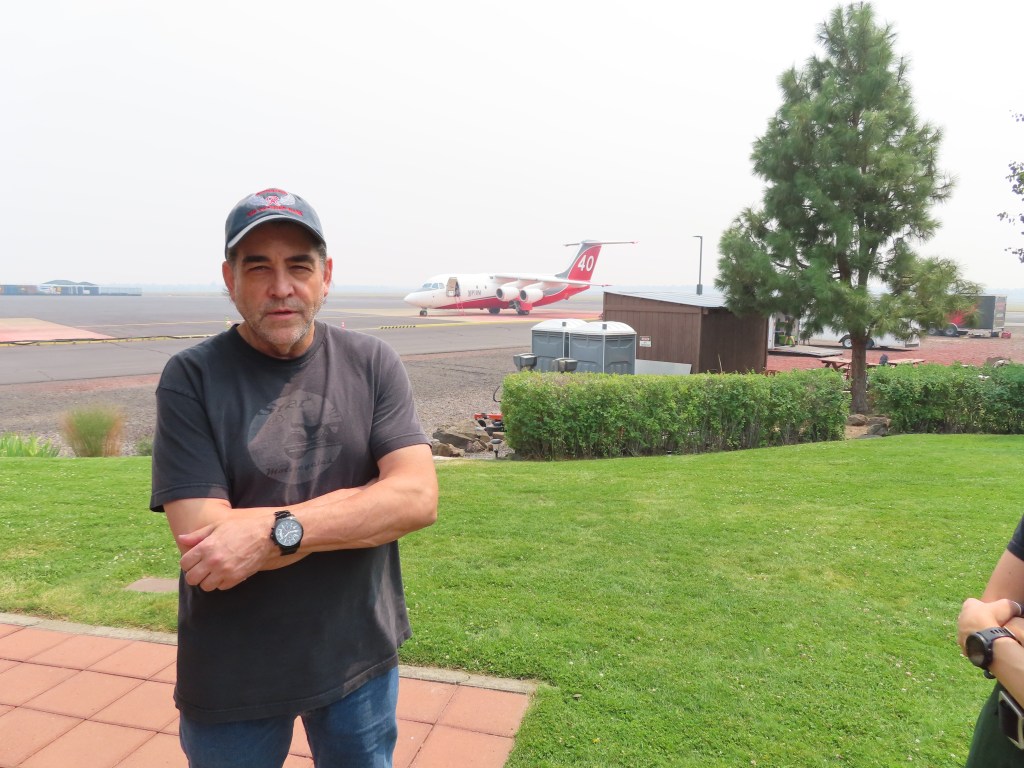
Luckily, they haven’t run out of fuel or retardant, Graff said.
The Redmond Air Base is one of five regional bases where tankers can refill on retardant, which comes in large powder bags and is mixed with liquid before being pumped into tanks. Large Air Tankers, or LATs, can carry between 2,000 and 4,000 gallons of retardant, while Very Large Air Tankers, or VLATs, can hold around 9,000 gallons. There are only a few of those planes available, and they are too large and heavy to land at the Redmond Air Base.
There are also Single-Engine Air Tankers, or SEATs, which resemble bush planes, and “amphibious” water scoopers that skim the surface of a lake to collect water. Chinook helicopters — which resemble a flying bus with front and rear blades — formerly used by the military can be outfitted with long hoses to suck up thousands of gallons of water, dropped either in a long spray or directly above a burning tree.
“They can hover over a tree and they can drop all 2,600 gallons in about three seconds. It just blasts through the tree, rips branches off the tree, and it’s one of the most effective ways to put out large fires in trees,” said Andrew Sawyer, a partner with Kawak Aviation, a Bend-based company that designs and builds aerial firefighting systems.

In the aerial firefighting world, there are only a few aircraft that were built for the specific purpose of aerial firefighting. Airliners must go through the process of ripping out seats and assembling large metal tanks with drop doors, while military helicopters must also be outfitted with hoses and tanks.
That process is time consuming and expensive, said Bill Thomas, director of flight operations at Aero-Flight, the Spokane-based company. The modified aircraft must go through the multi-year process of federal government certification. It also takes years to train the pilots, Thomas said.
“There’s only a handful of vendors that do this,” Thomas said. “It’s a very specialized arena in which we operate — a very unforgiving arena.”
This article appears in the Source August 6, 2026.
MAKE LOCAL JOURNALISM HAPPEN




Good story.