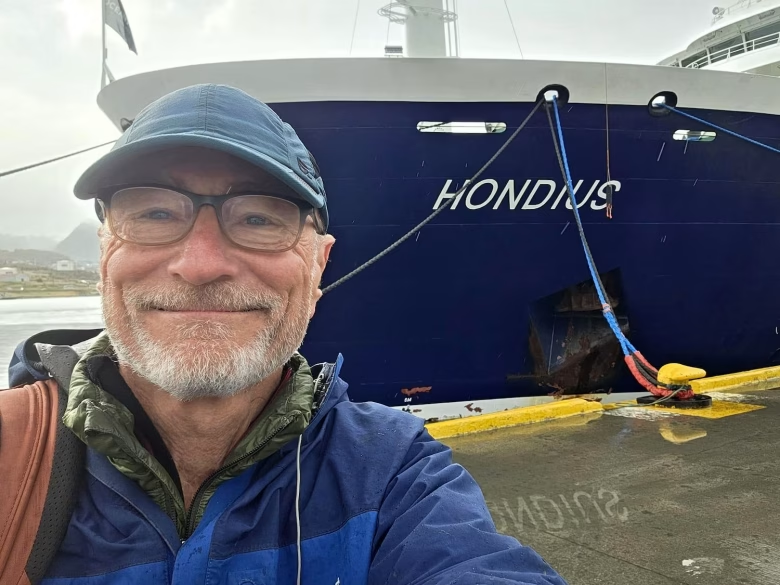
This past Friday, July 17, Dr. Stephen Kornfeld, a semi-retired Bend oncologist, was in Klamath Falls viewing a bird that he hadn’t seen before: a Least Bittern. An avid birder, he was on board the Dutch cruise ship MV Hondius in April when the Andes hantavirus spread — a rare strain that can transmit person-to-person. Kornfeld was onboard the 5-week cruise visiting remote islands in the South Atlantic to view unusual birds and mammals. He gained sudden fame after stepping in to assist sick passengers after the ship’s doctor became ill. Kornfeld says at least 80% of the cruise took place before anyone realized they had an outbreak.
“The sickness came on the boat April 1, and the first guy got sick April 5 and he died April 11. But because he died, the trip continued,” Kornfeld told the Source. The man’s wife became ill, but she got off the boat. Then another man became ill, but he was evacuated. With no one actually sick on the boat, the cruise continued. “Nobody on the boat or off the boat thought there was a disease spreading on the boat, so the trip carried on,” he said. “Sounds kind of weird, doesn’t it?”
Things changed at the end of April when several people on board became ill. At first, Kornfeld said he didn’t have protection. He searched the ship and found 2,000 masks, with 10 that were N95. He eventually found goggles and gowns which he also began wearing.
“I had access to the World Health Organization, and I read everything ever published on hantavirus. Didn’t take that long,” he said. “There were some other medicines I could use. There were steroids. There was Tylenol. There were anti-inflammatory drugs… From a pure medical standpoint, there wasn’t a lot to do… There are no proven therapies. It’s really supportive care.”
He says there were about 100 people on the ship and most of them remained calm and compliant.


“I feel good about the way I did step up and the way I remained calm and the way that I worked very hard, keeping everybody on the boat calm, because it really could have been very chaotic… You never know how you’re going to respond in those kinds of circumstances until you’re in those circumstances.”
The Andes hantavirus has a 30% fatality rate. Altogether there were a dozen infections on board the ship and three deaths. As a precaution, Kornfeld was held in quarantine for 42 days. He says the worst part of the ordeal was his time in Nebraska, where he says he was forced by the federal government to remain. He was kept 24 hours a day in a soundproof room where he couldn’t even hear the birds outside his window. “A very extreme government overreach coming from a government that prides itself on personal freedom and lack of health restrictions. So, after 21 days, I then planned on going home, but the government started throwing barriers. They were forcing people, without any medical justification, to stay in Nebraska. Oregon really stepped up to the plate to help get me home.”
Kornfeld hasn’t stopped talking about his experience. He’s scheduled to speak at the Rotary club, a Central Oregon bird conservancy and the Oregon Health & Science University wilderness medicine conference. He will also give a talk at the Deschutes Brewery Public House in downtown Bend on July 30, which will be moderated by Dr. Archie Bleyer. Central Oregon Medical Society is hosting the free event. No registration or membership is required to attend. Central Oregon Medical Society has been in Central Oregon for a century, connecting medical providers with one another.
While much has been reported about Kornfeld’s front row seat to the viral outbreak, he was on the cruise for birdwatching. In fact, according to World eBirders, Kornfeld is the second most accomplished birder in the world. At last check, he had seen 9,938 species.
“I like trying to go to areas of the world that still have wilderness left, and it’s very hard to find that. Most of the world has been radically altered, and there’s just no wilderness. I mean, the Philippines, Indonesia, Malaysia — it’s all been cut down, and there’s nothing left. And here’s a chance to go to some very remote areas with breathtaking landscapes,” he said, explaining why he was on the cruise.
Kornfeld, who’s 69, spends about seven months of the year traveling. His next bird trip will be to islands north of Madagascar, followed by an excursion to Chile. His overall goal is to see a bird from every family. Experts generally recognize about 250 unique bird families globally with more than 11,000 individual species.

“I love thinking about the evolution of birds and the way birds have evolved on the planet, and so much of it has to do with, you know, the way that Earth has changed over millions of years.” He explains, “I try to see birds that are on the verge of extinction. That’s kind of a mixed blessing because there are very few of them left. It takes a lot of work to see them, but at the same time, I feel that we’re in a place in the history of the planet in which I’m seeking to see birds that will not be there in 10 years. They will be gone forever and that reminds me how hard we’ve been on the planet.”
Kornfeld was recently in England where he attended a bird fair. “I ran into one of the people I took care of on the boat,” he said. “I couldn’t believe it. I just had so much emotion. It was emotional for him and his daughter cried and hugged me and thanked me…. I think there are a lot of lessons here for me. I don’t want life to go back as it was. I want it to go forward with maybe a little different perspective for myself and maybe that’s what I need to be talking about.”
Dr. Stephen Kornfeld
Thu, July 30 6:30-8pm
Deschutes Brewery Public House (Upstairs)
1044 NW Bond St, Bend
https://comedsoc.org/july-med-talk-2-2/
Free
This article appears in the Source July 23, 2026.
MAKE LOCAL JOURNALISM HAPPEN