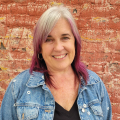
Not much seems to slow down Ryan Barbee. The 27-year-old Bend resident is an avid skier, recently began scuba diving and tried wakeboarding for the first time this summer. She also plans to start riding her new bike up Pilot Butte a few times a week but says “I’m worried because I know it’s going to be super tiring.”

That’s an understatement, especially given that she’ll be tackling the steep and steady uphill climb using just the strength of her arms. Again, not much seems to stop Barbee from pursuing the outdoor sports she loves, not even a broken neck. The young woman was paralyzed in an accident several years ago but continues to pursue an active lifestyle, thanks in part to grants that help her purchase adaptive sports equipment.
Like many avid cyclists, Barbee doesn’t have just one bike. She has two, an adaptive mountain bike and a new road bike. Grants from the Kelly Brush Foundation, a Vermont nonprofit that helps people with spinal cord injuries access and enjoy sports through grants, education and community programs, helped Barbee purchase both bikes.
“Everyone who reviewed Ryan’s grant application was incredibly impressed with her passion and excitement to be active and connect with their community through an active lifestyle,” said Kelly Brush, the nonprofit’s founder who suffered a spinal-cord injury in 2006 during a collegiate ski race. “Recovering from a spinal cord injury is hard and requires a lot of prescriptive work under medical supervision. Adaptive sports help survivors break free from the monotony of medical care and physical therapy offices while finding joy – and healthy living – in activity by engaging with the world, moving their bodies, and spending time with family and friends. I’m so excited to see how this new equipment helps Ryan live a fulfilled, active life.”
Barbee’s newest bike, the one she plans to ride up Pilot Butte, is a Bowhead RX that has two articulating wheels up front and one back wheel. Rather than handlebars, it has two hand levers.
“I got that one primarily for exercise,” Barbee said. “There’s just so many gravel and nice paved paths around Bend. It’ll be my more casual workout bike. It’s quite a workout because you’re cranking with your arms to get the bike to propel forward.”

Barbee got hooked on mountain biking several years ago and has a Bowhead Reach, which she uses for singletrack riding. It has full suspension, an articulating front end and handlebars with a throttle. She picked up the sport after attending a three-day “Turns and Burns” camp with Oregon Adaptive Sports and the Kelly Brush Foundation, in which participants ski in the morning and cycle in the afternoon. She was hooked.
“I never mountain biked before, which I think is a big part of the reason that I like it. I don’t have something to compare it to, like skiing,” she said. “I can kind of easily get frustrated with skiing because it’s not the same experiences I used to have.”
Five years ago, Barbee and some friends decided to ski through a terrain park at the end of a long day on the mountain.
“We were going through the park and hitting up some pretty big jumps. No one saw how I landed, but yeah, I was just going too fast and too big over some big jumps,” Barbee said, explaining that she broke her neck at the C6 vertebrae. “Technically, I’m quadriplegic, but my injury is incomplete, so I still have some function in my arms. I have some paralysis in my left hand and a little bit in my right hand, and I’m a full-time wheelchair user.”
While in rehab recovering from her accident, a recreational therapist explained how she could apply for grants to help her purchase adaptive sports gear. She knew she wanted to get back on the snow, so she began looking into the process. Living in Seattle at the time, repeated cancellations of adaptive ski lessons frustrated the young woman, so she’d make the trek to Bend to train with OAS, a nonprofit organization that facilitates access to outdoor recreation opportunities and experiences for people with disabilities, including snow sports, cycling, golf and paddling. She’s now an ambassador for the organization. Two years ago, she made the move to Central Oregon.
The young athlete actually works for Bowhead as a community coordinator, a remote position that entails marketing duties and then extensive travel during the biking season to several bike festivals and races.
“I get to go do demo rides with people and show them the bikes,” she said. “I’m spreading the word and helping people decide what kind of bike they might want, and I get to take them on their first ride. That’s my favorite thing to do, is take someone on their first ride on an adaptive bike because they’re just so stoked.”
Barbee said she’s also used grants from High Fives Foundation and Victoria’s Victory, nonprofits that assist adaptive athletes, to fund her bike purchases. Both bikes retail for around $20,000, she said, but it’s money well spent, as biking has introduced her to a “whole new world.
“The community of adaptive mountain bikers around the U.S. and Canada is super awesome, and it led to me meeting all of my amazing friends that are also in wheelchairs that ride adaptive bikes,” she said. “It’s been a foot in the door to an amazing community of people that like to do the same stuff as me.”
MAKE LOCAL JOURNALISM HAPPEN